30 April 2026 - 16:15, Room 00.002 (ZPD)
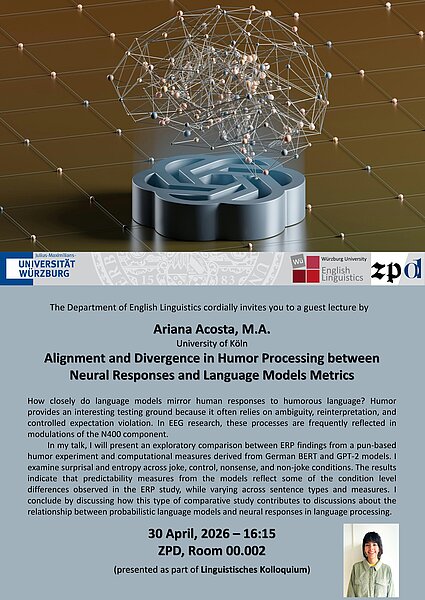
How closely do language models mirror human responses to humorous language? Humor provides an interesting testing ground because it often relies on ambiguity, reinterpretation, and controlled expectation violation. In EEG research, these processes are frequently reflected in modulations of the N400 component.
In my talk, I will present an exploratory comparison between ERP findings from a pun-based humor experiment and computational measures derived from German BERT and GPT-2 models. I examine surprisal and entropy across joke, control, nonsense, and non-joke conditions. The results indicate that predictability measures from the models reflect some of the condition level differences observed in the ERP study, while varying across sentence types and measures. I conclude by discussing how this type of comparative study contributes to discussions about the relationship between probabilistic language models and neural responses in language processing.