Insights from the Proto-Śāradā Project
At first glance, the term may appear technical, even provisional. Yet it refers to a crucial and still insufficiently explored phase in the history of writing in North-West India.
The term Proto-Śāradā refers to a transitional phase in the history of writing in North-West India. More specifically, it designates a script used roughly between the sixth and eleventh centuries CE in regions such as Gandhāra and Kashmir. These forms occupy a transitional position between late Brāhmī scripts and the fully developed Śāradā script, which later became one of the most important writing systems for Sanskrit texts. Chronologically and geographically, its use coincides with major political formations of the early medieval period, including the Palola Shahis of Gilgit as well as the neighbouring Turk and Hindu Shahi dynasties in present-day Afghanistan and northern Pakistan. The script thus belongs to a period of profound political, cultural, and administrative transformation.
Proto-Śāradā is therefore not merely a preliminary stage on the way to classical Śāradā, but a historically meaningful phase in its own right. While it clearly develops out of northwestern Brāhmī traditions, it also shows notable affinities with contemporary northeastern scripts, pointing to wider networks of scribal knowledge and practice.
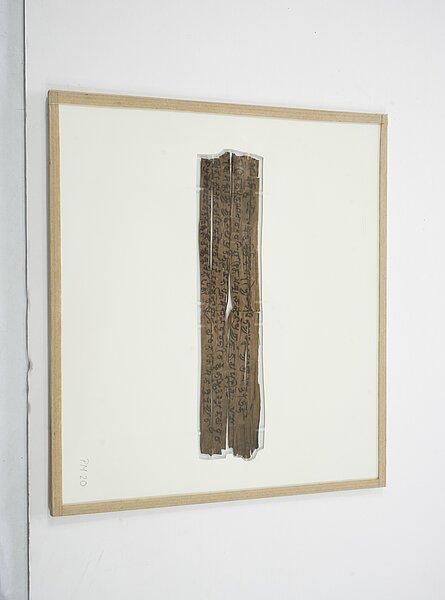
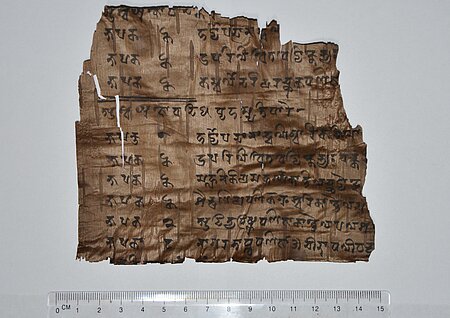
In recent years, the significance of Proto-Śāradā has been further underscored by the discovery of previously unknown administrative birch-bark manuscripts. These documents, which complement the epigraphic material, provide rare insights into everyday administrative practices and written communication beyond monumental inscriptions. At the same time, they broaden the material basis for studying Proto-Śāradā and highlight its role not only in religious or commemorative contexts, but also in routine administrative use.
Despite its significance, Proto-Śāradā has long remained marginal in epigraphical and palaeographical research. Inscriptions and manuscripts alike have often been studied in isolation, without being analysed as part of a coherent corpus. The Proto-Śāradā Project approaches this transitional script phase as a key source for understanding both the evolution of writing systems and the historical contexts in which they were embedded.
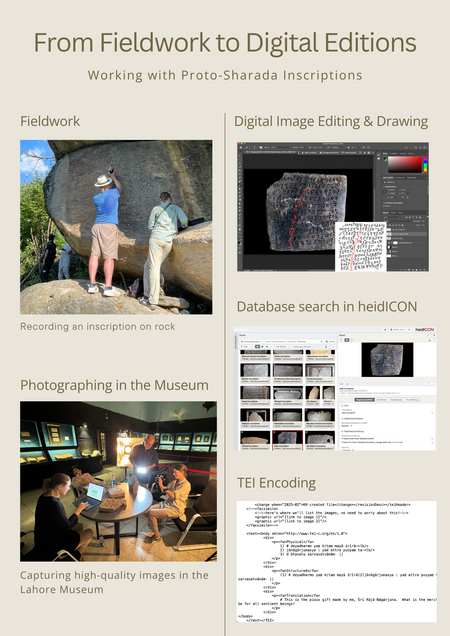
Work on Proto-Sharada inscriptions begins in the field, where inscriptions are documented in situ or in museum collections. Many of these objects are weathered, fragmented, or difficult to read, making careful photographic documentation essential. Lighting, angle, and surface structure often determine which traces of writing can be captured at all.
These early decisions already shape the later digital work. Once the material enters the digital environment, images are reviewed and compared, readings are proposed, and uncertainties become visible. This is particularly important for Proto-Sharada, a transitional script characterised by variation in letter forms and scribal practice.
Digital tools allow this variability to be handled systematically. Inscriptions are not only transcribed and translated, but also enriched with structured metadata on script forms, layout, and material features. This makes it possible to compare inscriptions across the corpus and to identify patterns that would remain invisible in isolated editions.
At the same time, digital processing does not replace epigraphical interpretation. Rather, it makes scholarly decisions explicit and revisable. The digital edition thus functions as a dynamic research space, closely linked to observations made during fieldwork.
By connecting material documentation with digital analysis, the project approaches Proto-Sharada inscriptions both as texts and as historical artefacts embedded in specific social and cultural contexts.
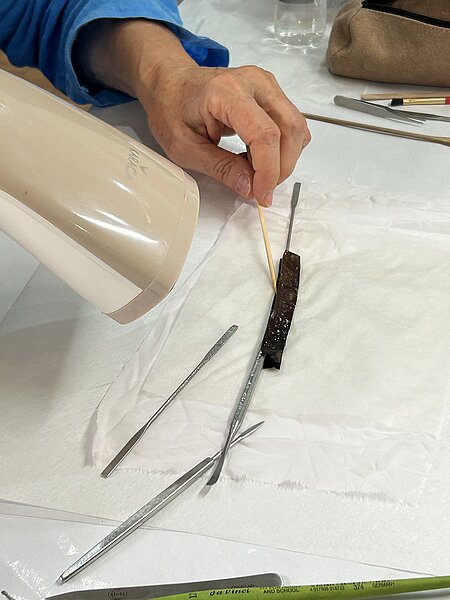
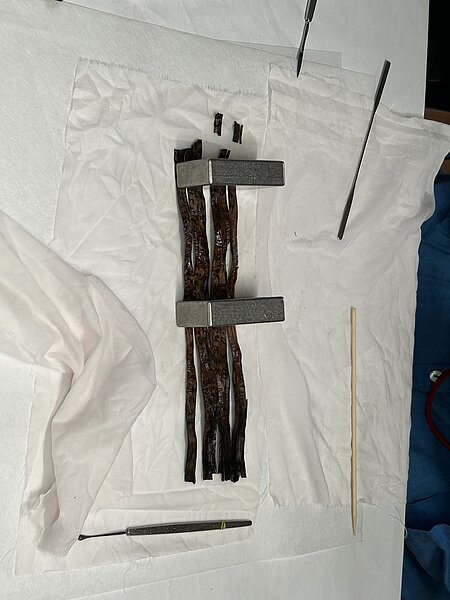
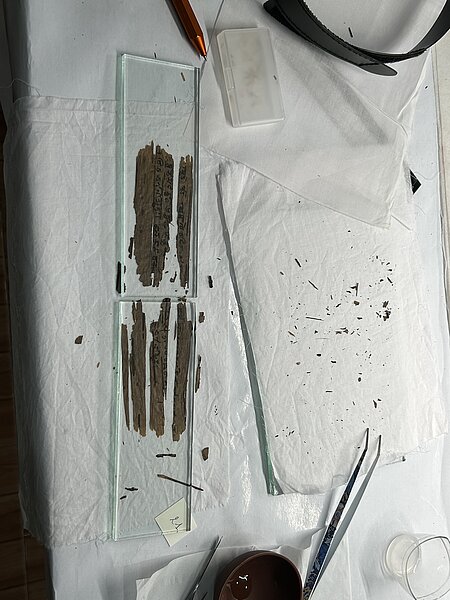
The Proto-Sharada documents are written on fragile birch bark and have survived centuries of folding, breaking, and decay. Before they can be read and studied, the fragments must therefore be carefully conserved, separated, and unfolded.
Restoration does more than make the texts accessible: folds, tears, and the arrangement of fragments can reveal how the documents were originally made, used, and stored. In this way, conservation becomes an essential part of reconstructing both the manuscripts and the world of writing in which they were created.