Press & Testimonials
Press
See also einBLICK, 11.06.2026
„Würzburg – die irische Stadt auf dem Kontinent“: Unter diesem Motto stand der Besuch der irischen Botschafterin Maeve Collins und des Generalkonsul Irlands in München James C. O’Shea an der Universität Würzburg Ende Mai.
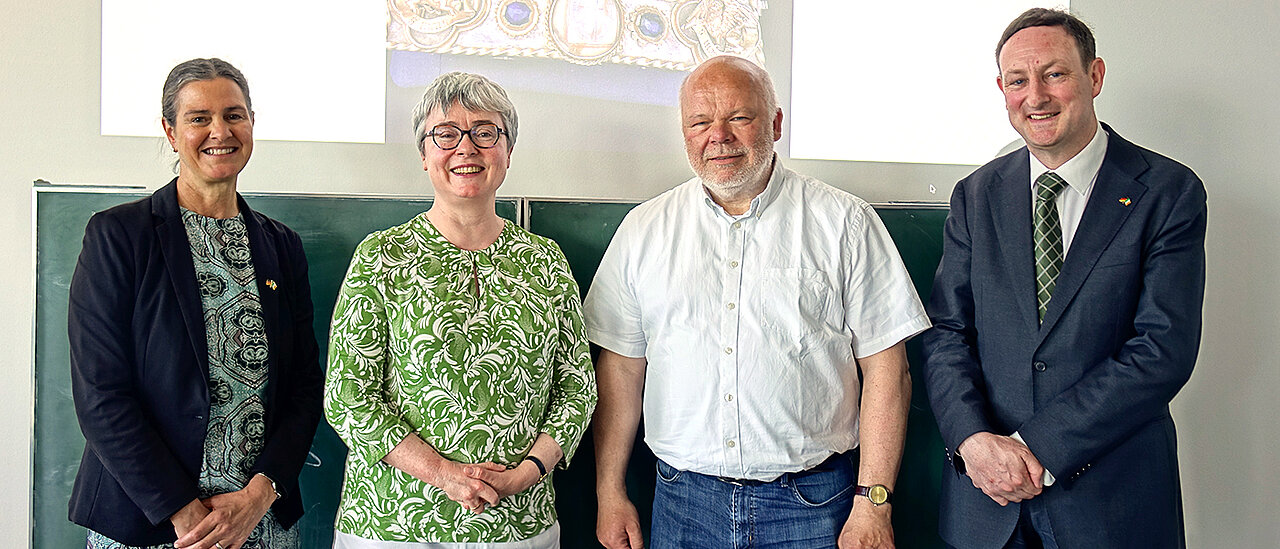
Maria Eisenmann, Maeve Collins, Matthias Fleckenstein und James C. O’Shea während ihres Treffens an der JMU. (Bild: ISWÜ)
Im August 2024 hat Maeve Collins ihr Amt als Botschafterin von Irland in der Bundesrepublik Deutschland in Berlin angetreten. Im selben Monat richtete Irland ein Generalkonsulat in München ein, das für Bayern und Baden-Württemberg zuständig ist. James C. O’Shea wurde zum ersten irischen Generalkonsul in München ernannt. Jetzt hat Botschafterin Collins in Begleitung von Generalkonsul O‘Shea in dieser Funktion zum ersten Mal der Universität Würzburg einen Besuch abgestattet.
Würzburg hat für die Irin eine besondere Bedeutung: „Irlands Beziehungen zu Deutschland sind tief und stark. Sie reichen bis ins siebte Jahrhundert zurück, als der heilige Killian von der irischen Grafschaft Cavan nach Würzburg in Bayern reiste. Seitdem gibt es eine dauerhafte Verbindung zwischen unseren Kulturen“, schreibt sie auf der Webseite der Botschaft.
Irish Studies: Ein deutschlandweit einzigartiger Schwerpunkt
Begrüßt wurde Maeve Collins am 28. Mai 2026 vom Team der Irish Studies Würzburg (ISWÜ). Dieses eine der wenigen deutschlandweit Zentren hatten die Professorinnen Ina Bergmann und Maria Eisenmann im Jahr 2020 ins Leben gerufen.
In ihrem Vortrag für den Besuch aus Irland zeichnete Maria Eisenmann die lange und vielschichtige Verbindung zwischen Irland und Würzburg von historischen Meilensteinen bis hin zu aktuellen Kooperationen nach. Ein herausragendes Beispiel dieser Beziehung ist das Kilians-Evangeliar, eines der wertvollsten Werke der Universitätsbibliothek, das den Beginn des kulturellen Austauschs markiert.
Die Irish Studies Würzburg (ISWÜ) sind heute ein zentraler Motor dieser lebendigen Verbindung. Als Teil des europaweiten Netzwerks der European Federation of Associations and Centres of Irish Studies (EFACIS) ist Würzburg eingebunden in eine Gemeinschaft von rund 50 akademischen Zentren in über 25 Ländern. „Damit ist ISWÜ nicht nur lokal verankert, sondern international vernetzt und trägt dazu bei, Würzburg als wichtigen Standort der Irish Studies in Europa sichtbar zu machen“, wie Eisenmann sagte.
Vielfältige Angebote und Aktivitäten
Vor Ort verfolgt ISWÜ das Ziel, Räume für Austausch und Zusammenarbeit zu schaffen: zwischen Wissenschaftlerinnen und Wissenschaftlern, Promovierenden, Studierenden der Anglistik und allen, die sich für Irland jenseits der akademischen Welt interessieren. Die inhaltliche Bandbreite reicht von der Analyse einzelner literarischer Werke und sprachlicher Phänomene bis hin zur umfassenden Erforschung von Geschichte und Kultur Irlands. In der Praxis zeigt sich dies in vielfältigen Aktivitäten wie Lesungen, Gastvorträgen, Workshops, Studientagen, Symposien, Konferenzen und kulturellen Veranstaltungen wie der Irish Itinerary.
Auch darüber hinaus wird die irische Kultur in Würzburg lebendig gehalten. Die Deutsch-Irische Gesellschaft Würzburg, vertreten durch Matthias Fleckenstein und Emma Phelan, engagiert sich seit Jahren für den kulturellen Austausch. Einen weiteren wichtigen Beitrag leistet Dr. Mark Darling am Lehrstuhl für Vergleichende Sprachwissenschaft, insbesondere durch seine Forschung zu den keltischen Sprachen.
Studierende berichten von ihren Austauscherfahrungen
Ein besonderes Highlight des Besuchs waren die Erfahrungsberichte irischer Studierender, die im Rahmen von Austauschprogrammen wie Erasmus in Würzburg leben. Sie schilderten eindrucksvoll, wie sie die Verbindung zwischen ihrer Heimat und Würzburg persönlich erleben und mitgestalten.
„Der Besuch hat eindrucksvoll gezeigt, dass die Verbindung zwischen Würzburg und Irland weit mehr ist als ein historisches Relikt. Sie lebt durch die Menschen, die sie gestalten, durch Forschung, Lehre und den studentischen Austausch“, lautet Maria Eisenmanns Fazit nach dem Besuch von Maeve Collins. Sie und das gesamte ISWÜ-Team hätten sich sehr über den Besuch der irischen Botschafterin und des Generalkonsuls gefreut. So werde Würzburg auch in Zukunft ihrem Ruf als „irische Stadt auf dem Kontinent“ gerecht.
Kontakt
Prof. Dr. Maria Eisenmann & Prof. Dr. Ina Bergmann, Irish Studies Würzburg,
T +49 (0)931-31-88529, E-Mail: maria.eisenmann@uni-wuerzburg.de, ina.bergmann@uni-wuerzburg.de
Webseite der Irish Studies
Weitere Bilder
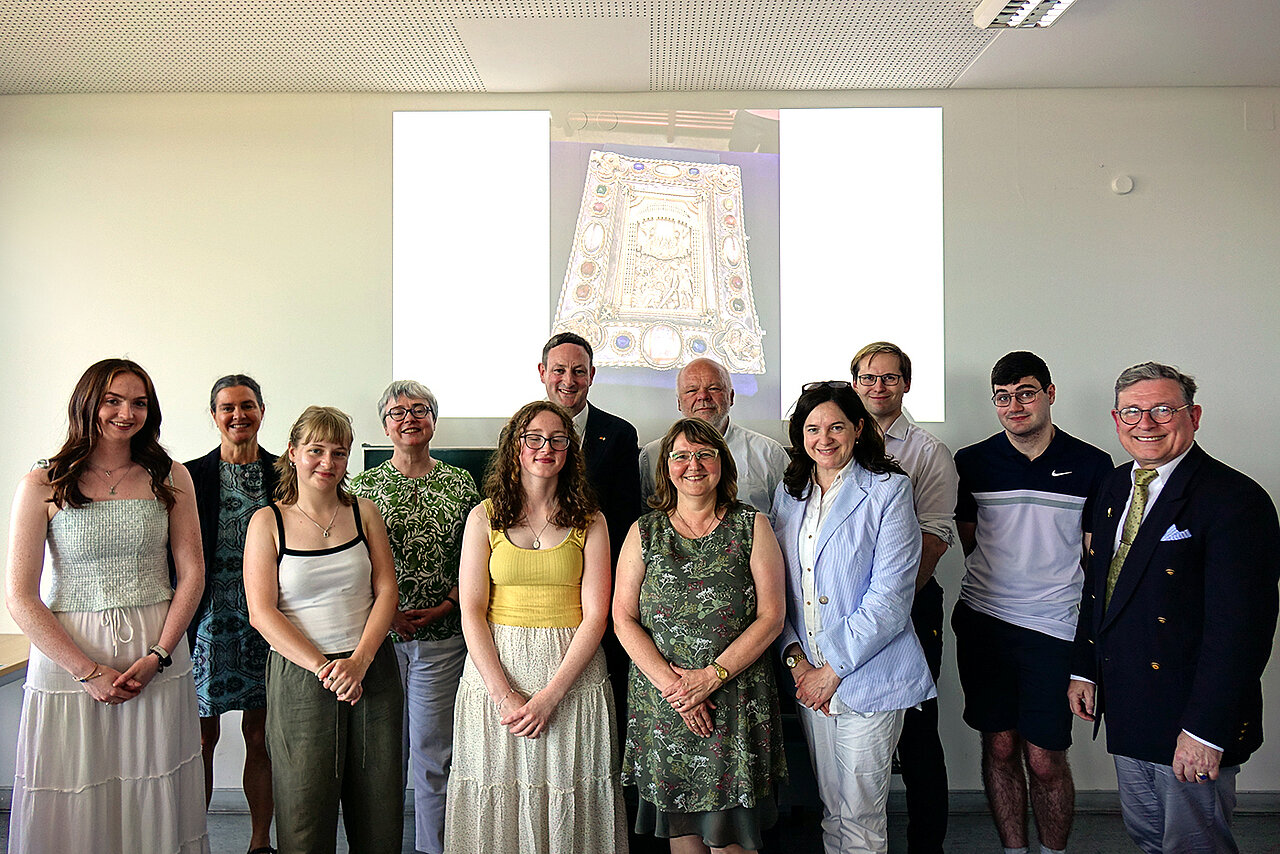
Alle Teilnehmerinnen und Teilnehmer des Treffens vor einer Aufnahme des Kiliansevangeliars. (Bild: ISWÜ)
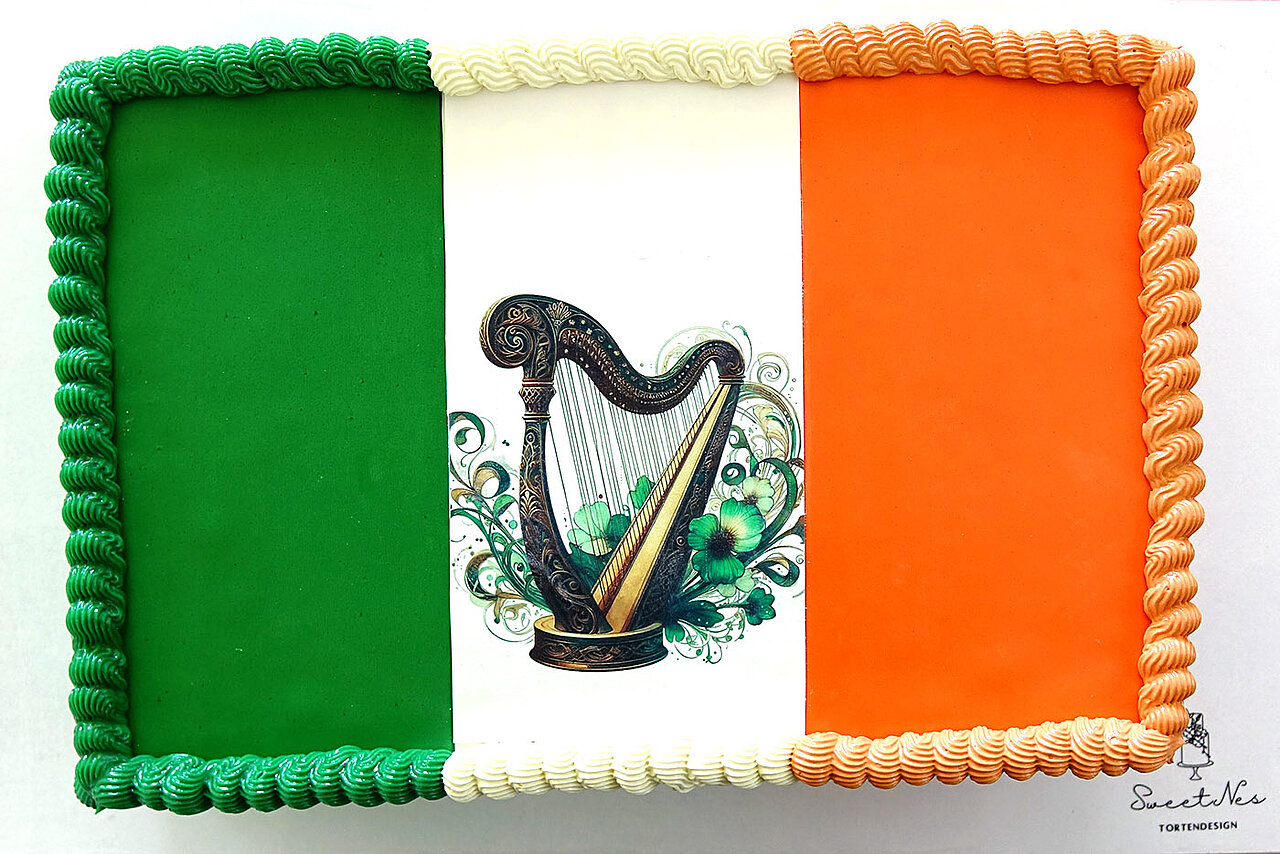
Ein besonderes Schmankerl für die Gäste aus Irland: Eine Torte in den Landesfarben. (Bild: ISWÜ)
Von ISWÜ
See also einBLICK 11.03.2025
Schicksale irischer Immigrantinnen in den USA
Irisch-amerikanische Studien: Diesen Schwerpunkt bietet in Deutschland nur die Würzburger Anglistik & Amerikanistik. Pia Becke schreibt auf diesem Gebiet ihre literaturwissenschaftliche Masterarbeit.

Am 17. März ist St. Patrick‘s Day. Menschen mit irischen Wurzeln feiern diesen Tag auf der ganzen Welt, zum Beispiel wie hier in Chicago, wo der Chicago River grün eingefärbt wurde – ein schönes Beispiel für irische Kultur in den USA. (Bild: Thananit / Adobe Stock)
Für ihr Masterstudium ist Pia Becke von Trier nach Würzburg gewechselt. Warum sie von der Mosel an den Main gezogen ist? Es war das inhaltlich breit gefächerte Programm des Würzburger Masterstudiengangs „English-Speaking Cultures“, das sie überzeugte.
In einem Seminar ihrer Würzburger Professorin Ina Bergmann kam die Studentin mit einem Thema in Kontakt, von dem sie bis dahin wenig wusste: Manche Regionen in den USA sind stark irisch geprägt, weil es über längere Zeit eine stetige Auswanderung von Irland nach Nordamerika gab.
Eine außerordentlich große Emigrationswelle gab es zum Beispiel Mitte des 19. Jahrhunderts. Damals vernichtete ein Pilz mehrere Jahre hintereinander die Kartoffelernten in Irland, was zu einer großen Hungersnot führte. Eine Million Menschen kehrten der Insel den Rücken.
Viel Literatur zur irisch-amerikanischen Geschichte
Aus Not die Heimat verlassen, sich in einem fremden Land zurechtfinden, sich dort integrieren – weltpolitisch ist das immer noch aktuell. „Ich fand das Thema sehr interessant und habe festgestellt, dass es unglaublich viel Literatur gibt, die sich mit der irisch-amerikanischen Immigrationsgeschichte befasst“, sagt Pia Becke.
Die Studentin merkte, dass sich diese Literatur vorwiegend um Männer dreht und meist auch von Männern geschrieben wurde. Doch welche Rolle spielen die weiblichen Figuren? Aus dieser Frage heraus beschloss sie, in ihrer Masterarbeit nun weibliche Perspektiven und die literarische Darstellung von Frauenfiguren in den Mittelpunkt zu rücken.
Studentin nimmt drei neuere Romane in den Blick
Für ihre Arbeit hat sie drei Romane ausgewählt, in denen Schicksale und Familiengeschichten irischer Immigrantinnen beschrieben sind. Alle drei sind erst wenige Jahre alt, alle spielen um die Mitte des 20. Jahrhunderts in den USA.
Eines der Bücher ist die Auswanderungsgeschichte Brooklyn (2009) von Colm Tóibín, die 2015 verfilmt wurde. Der irische Schriftsteller erzählt darin vom Heimweh und den Integrationsproblemen der jungen Irin Eilis Lacey, die 1951 in die USA emigriert. Außerdem untersucht Pia Becke den Roman We Are Not Ourselves (2014) von Matthew Thomas, ein über Generationen reichendes Epos über eine irisch-amerikanische Familie. Schließlich befasst sie sich mit Alice McDermotts The Ninth Hour (2017). Dieses Werk dreht sich um eine irisch-amerikanische Gemeinschaft von katholischen Nonnen in Brooklyn.
Im August 2025 soll die Masterarbeit fertig sein. Wie es dann weitergeht? Pia Becke weiß schon, dass sie in die Wissenschaft gehen möchte: Sie strebt eine Doktorarbeit im Bereich American Cultural Studies bei Professorin Mary Ann Snyder-Körber an. Damit wird sie der Universität Würzburg vorerst erhalten bleiben.
Einzigartiger Schwerpunkt in Deutschland
Den Schwerpunkt „Irisch-amerikanische Studien“ gibt es in dieser Form in Deutschland nur an der Julius-Maximilians-Universität (JMU) Würzburg. Dass die Studierenden ihn hier wählen können, ist den Professorinnen Ina Bergmann und Maria Eisenmann zu verdanken: Sie haben 2020 die Irish Studies Würzburg (ISWÜ) gegründet und seitdem viele Aktivitäten entfaltet.
Im Sommersemester 2025 setzen die ISWÜ in Forschung und Lehre erneut einen Fokus auf die irisch-amerikanischen Studien. Unter anderem hält eine renommierte amerikanische Expertin einen Gastvortrag zum Roman Long Island (2024), der Fortsetzung von Tóibíns Brooklyn.
Der Masterstudiengang „English-Speaking Cultures“ bietet noch einige weitere interessante Schwerpunkte an: Sound Studies, Linguistic Perspectives, Environmental Humanities, Cultural Studies, American Studies oder Global Literatures. Bewerbungen sind jeweils bis 15. Juli oder 15. Januar möglich.
17. März: St. Patrick’s Day
Der St. Patrick’s Day am 17. März ist der Gedenktag für den irischen Bischof Patrick, der im fünften Jahrhundert lebte. Er begründete in Irland die Tradition der katholischen Kirche. Menschen mit irischen Wurzeln feiern den Tag auf der ganzen Welt mit Paraden und Volksfesten. Dabei steht die Farbe Grün als Symbol der nationalen Zugehörigkeit im Mittelpunkt.
Weitere Informationen
Masterstudiengang English-Speaking Cultures
Irish Studies Würzburg (ISWÜ)
Von Robert Emmerich
See also einBLICK 24.10.2023
Irish Studies begrüßen Gastprofessorin
Prof. Dr. Maureen O’Connor erforscht die weibliche Perspektive oder die Rolle von Tieren in der irischen Literatur des 19. und 20. Jahrhunderts. Im neuen Wintersemester teilt sie ihr Wissen als Gastprofessorin an der Uni Würzburg.
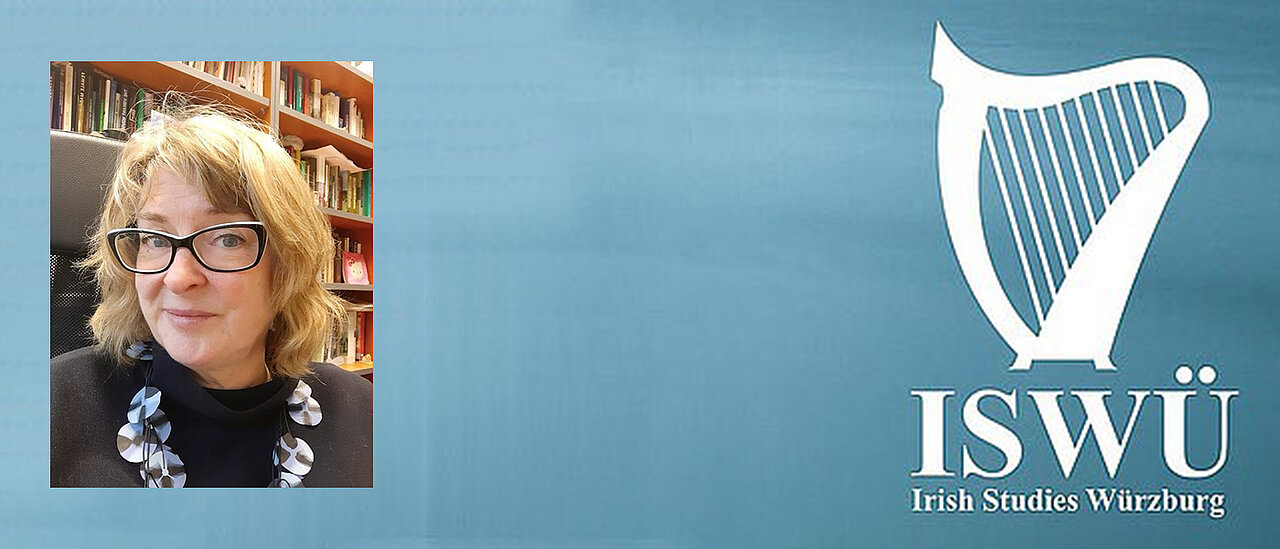
Maureen O’Connor freut sich auf eine spannende und lehrreiche Zeit in Würzburg. (Bild: privat / ISWÜ)
Die Irish Studies Würzburg (ISWÜ) freuen sich, Maureen O'Connor vom irischen University College Cork als Gastprofessorin im Wintersemester 2023/24 an der Julius-Maximilians-Universität Würzburg (JMU) begrüßen zu dürfen. Möglich macht das die Finanzierung durch das Emigrant Support Programme (ESP) der irischen Botschaft in Berlin. Weitere Unterstützung für die Unterbringung stellt das Siebold-Collegium Institute for Advanced Studies Würzburg (SCIAS) bereit.
Der Kontakt nach Würzburg war 2021 entstanden, als Maureen O’Connor einen Vortrag zu einem Online-Workshop an der JMU beisteuerte. Trotz des rein digitalen Formats empfand sie die Erfahrung schon damals als „anregend und gesellig“ und „hoffte, bald die Gelegenheit zu haben, die Universität persönlich zu besuchen.“
Eintauchen in Kultur und Bildungssystem
Diese Chance ergibt sich nun in Form der Stelle als Gastprofessorin. Darüber zeigt sich die Literaturwissenschaftlerin hocherfreut. „Ich konnte mein Glück kaum fassen“ beschreibt O’Connor ihre Gefühlslage nach der Zusage aus Würzburg. Vergangene Aufenthalte an ausländischen Universitäten wären rein auf die Forschung beschränkt und kürzer gewesen. Jetzt reize sie besonders „die Aussicht auf ein umfassendes Eintauchen in eine andere Kultur sowie in ein anderes Bildungssystem und ein mir unbekanntes Institut.“
Gerade auf die anstehenden Lehrveranstaltungen blickt Maureen O’Connor mit viel Vorfreude. Einen herzlichen Empfang erlebte sie bereits bei einem Symposium für Doktorandinnen und Doktoranden der Environmental Humanities: „Die Studierenden hier in Würzburg sind eindeutig eine außergewöhnliche Gruppe, und ich freue mich darauf, von ihnen zu lernen“, so die Gastprofessorin. Speziell die Herausforderung, ihr bisher noch unbekannte Texte mit den Studierenden zu erarbeiten und zu diskutieren, sei vielversprechend.
Neben neuer fachlicher Erkenntnisse erhofft sich Maureen O’Connor vor allem, „zumindest ein bisschen Deutsch zu lernen.“
Abwechslungsreiches Programm
Im Rahmen ihres Aufenthalts wird Maureen O'Connor drei Kurse unterrichten: “The Comic Tradition in Irish Writing “, “Irish Women's Writing at the Fin de Siècle” und “The Natural World in Irish Women's Writing”.
Außerdem wird sie am Donnerstag, 30. November, einen Vortrag zum Thema "Haunted Nature in the Fiction of Edna O'Brien" halten.
Zusätzlich organisiert Maureen O’Connor gemeinsam mit den Professorinnen Ina Bergmann, Maria Eisenmann und Kirsten Sandrock von ISWÜ vom 21. bis 23. Februar 2024 ein internationales und interdisziplinäres Symposium zum Thema "The Animal in Ireland, Real and Imagined" an der JMU.
Zur Person
Maureen O'Connor ist Senior Lecturer in der Abteilung für Englisch am University College Cork in Irland. Sie hat zahlreiche Publikationen auf dem Gebiet der Irish Studies veröffentlicht und Grundsatzvorträge in Indien, Japan, Österreich, Spanien und Frankreich gehalten. Sie ist die Autorin von The Female and the Species: The Animal in Irish Women's Writing (2010). Weiterhin ist sie Mitherausgeberin einer Reihe prägender Bände ihres Forschungsbereichs.
Ihr neuestes Buch, Edna O'Brien and the Art of Fiction, das 2021 bei Bucknell University Press erschienen ist, wurde von der Schriftstellerin Éilís Ní Dhuibhne als "ein wunderbares Buch, unverzichtbar für jeden, der sich für Edna O'Brien oder die zeitgenössische irische Literatur interessiert" beschrieben. Derzeit schreibt O'Connor an einem Band für die Reihe der Cork University Press, Síreacht: Longings for Another Ireland, zum Thema Tiere.
Kontakt
Prof. Dr. Ina Bergmann, ina.bergmann@uni-wuerzburg.de
Prof. Dr. Maria Eisenmann, maria.eisenmann@uni-wuerzburg.de
Prof. Dr. Maureen O’Connor, maureen.oconnor@uni-wuerzburg.de
Artikel von Lutz Ziegler
See also einBLICK 22.11.2022
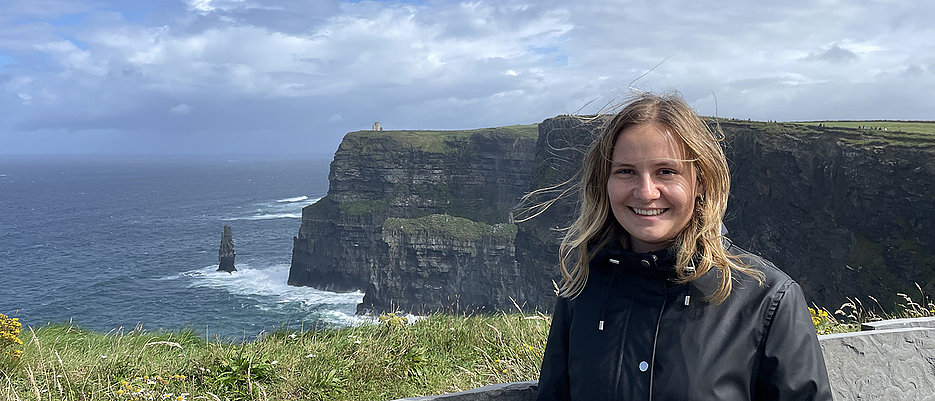
Marisa Ammersbach studiert in Würzburg Political and Social Studies mit Englisch im Nebenfach. Im Sommer absolvierte sie ein Praktikum am irischen University College Cork. Dabei arbeitete sie an einem über 380 Jahre alten Text.
Das Corpus of Electronic Texts, kurz CELT, ist die größte digitale Sammlung für Texte mit Bezug zu Irland. Beheimatet ist CELT am University College Cork (UCC) im Süden der Grünen Insel. Dort absolvierte Marisa im Juli und August 2022 ein Praktikum. Ihre Aufgabe: Einen frühneuhochdeutschen Text in ein modernes Schriftbild übertragen.
Marisa, die kurz vor ihrem Bachelor-Abschluss steht, war die erste Studierende der Julius-Maximilians-Universität (JMU) Würzburg, die die Möglichkeit für ein Praktikum bei CELT genutzt hat.
„Ich hatte gar nicht auf dem Schirm, dass man sowas beruflich machen kann“, erzählt sie und ergänzt, dass ihr „solche Textarbeit schon immer Spaß gemacht“ hat. Beim bearbeiteten Text handelte es sich um Erzählungen eines Militärkaplans, der während des 30-jährigen Krieges einen hochrangigen irischen Militär auf dem europäischen Kontinent begleitet hatte.
Auslandssemester light
Marisa hatte Ende 2021 durch eine E-Mail des Fachbereichs Anglistik & Amerikanistik von dem Praktikumsangebot erfahren und sich auch deshalb beworben, weil sie aufgrund von Corona ein geplantes Auslandssemester nicht antreten konnte: „Eigentlich hatte ich eine Zusage für Genua mit Erasmus+, aber daraus wurde dann leider nichts.“
Auch wenn das knapp dreiwöchige Praktikum kein Ersatz für ein ganzes Auslandssemester war, genoss Marisa ihre Zeit in Irland: „An den Wochenenden habe ich Ausflüge gemacht und zum Schluss noch einige Tage in Dublin verbracht. Es ist ein tolles Land mit sehr lieben und hilfsbereiten Menschen. Das war besonders schön, weil ich allein unterwegs war.“
Bei CELT arbeitete Marisa eng mit ihrer Supervisorin Beatrix Färber zusammen: „Das hat perfekt geklappt. Die Arbeit mit einem alten Text war für mich neu. Beatrix hat mir viel Freiheiten gelassen, war bei Fragen aber immer für mich da.“
Die Arbeit bei CELT
Auch Beatrix Färber war mit der Arbeit ihrer Praktikantin sehr zufrieden: „Marisa hat das wirklich gut gemacht. Ihr Text hatte fast 340 Seiten, alles in Fraktur gedruckt und in einer ungewohnten Sprache. Sie hat etwa die Hälfte geschafft, das ist sehr beachtlich.“
Der Text kam aus dem Münchner Digitalisierungszentrum der Bayerischen Staatsbibliothek, wo er abgescannt wurde. Da die Software allerdings nicht in der Lage ist, ihn komplett anzupassen, muss er von Hand redigiert und in ein modernes Schriftbild gebracht werden.
„Mögliche nächste Schritte wären dann eine Übersetzung in modernes Deutsch oder ins Englische“, erklärt Beatrix Färber.
Zusammenarbeit mit den Irish Studies Würzburg
Angeboten wird das Praktikum am CELT von den Irish Studies Würzburg (ISWÜ) der JMU. Professorin Maria Eisenmann, gemeinsam mit Professorin Ina Bergmann Initiatorin von ISWÜ, zeigt sich sehr erfreut über den geglückten Start dieser Kooperation: „Die Idee für das Praktikum entstand über den wissenschaftlichen Austausch mit Beatrix und anderen Historikern des UCC. Wir waren noch auf der Suche nach weiteren Angeboten für Studierende und fanden eine Kooperation mit CELT sehr gewinnbringend. Zusammen haben wir bereits verschiedene Veranstaltungen wie Gastvorträge, einen Studientag und ein Symposium realisiert. In Zukunft möchten wir diesen Kontakt noch ausbauen, wir streben zum Beispiel auch eine Erasmus-Kooperation an“, erklärt Eisenmann.
Informationen zum Praktikum finden sich auf der Seite von ISWÜ. Bewerbungen für Praktikumsplätze im Sommer 2023 sind noch bis zum 31. Januar 2023 möglich. Bewerben können sich alle Studierenden des Fachbereichs Anglistik & Amerikanistik.
Marisa jedenfalls kann das Praktikum „definitiv weiterempfehlen.“ Für sie war Irland eine durchweg positive Erfahrung.
Links
Weitere Informationen zu Internships der Irish Studies Würzburg
Zur digitalen Sammlung Corpus of Electronic Texts (CELT)
See also einBlick 21.06.2022
Mit der Geschichte Irlands und den Herausforderungen, vor denen das Land heute steht, befasst sich ein öffentliches Symposium in englischer Sprache. Dazu laden die Irish Studies Würzburg am 1. Juli 2022 ein.
Klimakrise, Digitalisierung, Corona-Pandemie, Totalitarismus, Rassismus und Sexismus: Das sind nur einige der Herausforderungen, vor denen die Gesellschaften der Welt im 21. Jahrhundert stehen. Irland und Nordirland sowie die Irinnen und Iren, die in anderen Ländern leben, müssen sich mitsamt ihren Partnern in Europa auch noch mit den Auswirkungen des Brexit auseinandersetzen.
Für die irische Insel sind die Folgen des Brexit politisch besonders brisant. Welche Strategien können helfen, die mit dem Brexit verbundenen europäischen und transatlantischen Herausforderungen zu meistern? Kann ein Blick zurück in die Geschichte Irlands Orientierung bieten und Ideen für die Gestaltung der Gegenwart liefern? Kann die jüngere Generation, ausgestattet mit dem Wissen über die Vergangenheit, eine bessere Zukunft gestalten?
Beteiligt sind Universitäten aus Irland, Belgien und Deutschland
Hier setzt das Symposium "History in Stories: The Irish Past and the Challenges of the Present" an: Sein Ziel ist es, Texte aus der irischen Vergangenheit sowie Texte über die irische Geschichte daraufhin zu untersuchen, ob sich aus ihnen Lehren ziehen lassen. Betrachtet werden sowohl fiktionale Texte als auch historische Dokumente.
Wissenschaftlerinnen und Wissenschaftler aus Literaturwissenschaft, Geschichte und Fachdidaktik (TEFL) werden sich der irischen „Geschichte in Geschichten“ nähern. Sie kommen vom University College Cork (Irland), vom Centre for Irish Studies der Katholischen Universität Leuven (Belgien) und von den Irish Studies der Universität Würzburg. Die drei Universitäten kooperieren bereits in Forschung und Lehre auf dem Gebiet der Irish Studies und wollen ihre Zusammenarbeit mit dem Symposium festigen und weiter ausbauen.
Organisiert wird das Symposium vom Team der Irish Studies Würzburg um die Professorinnen Ina Bergmann und Maria Eisenmann, beide vom Institut für Anglistik und Amerikanistik. Gefördert wird es von der Fritz Thyssen Stiftung, der irischen Botschaft und dem Universitätsbund Würzburg. Die Vorträge und Diskussionen laufen am Freitag, 1. Juli 2022, von 9:00 bis 18:30 Uhr in englischer Sprache.
Das Symposium findet als hybride Veranstaltung statt. Interessierte, die nicht aktiv als Vortragende oder Moderierende beteiligt sind, können online teilnehmen. Wer online teilnehmen möchte, kann sich bis 28. Juni 2022 mit einer E-Mail an irishstudies@uni-wuerzburg.de anmelden.
Weblinks
Symposium "History in Stories: The Irish Past and the Challenges of the Present".
See also einBLICK 13.04.2021
Zwei Professorinnen der Uni setzen mit Irland einen neuen interfakultären Schwerpunkt. Die Auftaktveranstaltung der „Irish Studies Würzburg“ findet am 16. April 2021 um 16:30 Uhr statt. Sie steht auch Nicht-Akademikern offen.
Logo der „Irish Studies Würzburg“. Die Auftaktveranstaltung findet am 16. April 2021 statt. (Bild: Universität Würzburg)
Der Brexit wird extreme Auswirkungen auf Irland haben. Die Ausschreitungen der letzten Tage in Belfast haben dies deutlich gezeigt. Welche Konsequenzen sie befürchten, davon berichten die nordirischen Autorinnen Colette Bryce und Jan Carson am 16. April beim Kick-off Event der „Irish Studies Würzburg“ (ISWÜ). Mit der virtuellen Veranstaltung wird das neu gegründete interfakultäre Forum ISWÜ an der Julius-Maximilians-Universität (JMU) Würzburg offiziell eröffnet. Eingerichtet wurde es bereits im vergangenen Sommersemester von den Professorinnen Ina Bergmann und Maria Eisenmann.
Enge Verbindung zu Irland
Irland, seit 1922 ein unabhängiger Staat und seit 1973 Mitglied der Europäischen Union, hat hierzulande viele Fans. Vor über 60 Jahren weckte Heinrich Böll durch sein „Irisches Tagebuch“ die Sehnsucht nach der grünen Insel. Wenige Jahre später begannen „The Dubliners“ für Irland zu begeistern. Maria Eisenmann, Inhaberin des Lehrstuhls für Fachdidaktik – Moderne Fremdsprachen an der JMU, fing in den 1990er Jahren Feuer. „Damals reiste ich auf eigene Faust für mehrere Wochen mit dem Auto über die Insel“, erzählt die Professorin, die seit 2015 in Würzburg forscht und lehrt.
Ob man immer in seiner Heimat lebt oder migriert, ist ein wesentlicher Unterschied, der die eigene Identität prägt. Viele Iren, die seit der Industriellen Revolution nach Amerika ausgewandert sind, können davon berichten. „Die Bezüge zwischen den USA und Irland sind vielfältig und faszinierend“, sagt die Amerikanistin Ina Bergmann. Durch Kontakte zu irischen Hochschulen begann sie, sich immer intensiver für irisch-amerikanische Literatur, Kultur und Geschichte zu interessieren. Der Wunsch, intensiver zu forschen, erwachte. Durch die Zusammenarbeit mit Maria Eisenmann kam es schließlich zur Einrichtung der ISWÜ.
Kooperation mit der Universität Cork
Dass das Forum gerade am 16. April offiziell aus der Taufe gehoben wird, hat einen speziellen Anlass: An diesem Tag jährt sich der Geburtstag des irischen Dramatikers John Millington Synge, der eine Weile an der JMU in Würzburg studierte, zum 150. Mal. Bei der Auftaktveranstaltung wird Jochen Achilles, emeritierter Amerikanistik-Professor der JMU, darauf eingehen. Weiter wird er aufzeigen, inwieweit Irland und die Iren mit Europa und der Welt verbunden sind. Schließlich wird er die Entwicklungen in den European Irish Studies sowie die Internationalisierung des irischen Dramas aus deutscher Sicht beleuchten. Dr. Damian Bracken, Dozent am University College Cork referiert über St. Columbanus, der als einer der ersten Iren Einfluss auf Europas Geschichte hatte.
In den kommenden Semestern soll das Forum ISWÜ Zug um Zug ausgebaut werden. Bereits in diesem Sommersemester wird in der Reihe „WueGlobal“ ein virtuelles Konversationsseminar unter Beteiligung der Universität Cork stattfinden. Außerdem wird es Lehrveranstaltungen und Gastvorträge zu Irland geben. Zudem planen Bergmann und Eisenmann ein interdisziplinäres Symposium zu Irland, bei dem Literaturwissenschaftler, Fachdidaktiker und Historiker zu Wort kommen sollen. Künftig würden die beiden Forscherinnen auch gern Gastprofessoren einladen.
Öffnung auch für Nicht-Akademiker
Das Forum kommt letztlich allen Bürgern zugute, die auf der Suche nach Experten zum Thema „Irland“ sind. Eisenmann und Bergmann wollen mit den „Irish Studies Würzburg“ ausdrücklich auch nicht-akademischen Kreisen Möglichkeiten zur Zusammenarbeit und zum internationalen Dialog eröffnen. Interessierte Bürgerinnen und Bürger mit Irland-Passion, die am 16. April am Kick-off-Event via Zoom teilnehmen, lernen dabei unter anderem den irischen Botschafter, Dr. Nicholas O’Brien, und auch Professorin Katharina Rennhak kennen, Präsidentin der European Federation of Associations and Centres of Irish Studies (EFACIS). „Irish Studies Würzburg“ gehört seit seiner Einrichtung EFACIS an.
ISWÜ ist ein ambitioniertes Projekt, das hervorragend nach Würzburg passt – hat die Domstadt doch eine über 1300-jährige Verbindung nach Irland. Im 7. Jahrhundert kamen die irischen Wandermönche Kilian, Kolonat und Totnan nach Franken, um hier den christlichen Glauben zu verbreiten. Kilian ist bis heute der bekannteste von ihnen. An ihn erinnert zum einen der Kiliansdom, zum anderen das „Kiliani“ als das größte kirchliche und weltliche Fest in der Region. Wegen dieser vielfältigen Bezüge gilt Würzburg als „die irische Stadt auf dem Kontinent“. Würzburger Irland-Liebhaber schlossen sich 1986 zur Deutsch-Irischen Gesellschaft zusammen, die ebenfalls mit ISWÜ kooperiert.
Mehr als nur Klischees
Selbst Irlandfans besitzen jedoch oft nur rudimentäre Kenntnisse in Irlandistik. Stereotype prägen das Bild. Beim Stichwort „Irland“ fällt den meisten Menschen die Farbe Grün ein, andere denken als erstes an irische Pubs. Was dran ist an landläufigen Klischees, kann am 16. April mit den Autorinnen Colette Bryce und Jan Carson diskutiert werden. Colette Bryce, 1970 im nordirischen Derry geboren, wurde mit dem britischen Literaturpreis Cholmondeley Award ausgezeichnet. Die Belfasterin Jan Carson erhielt 2019 für ihren Roman „The Fire Starters“ den Literaturpreis der Europäischen Union.
Dass man in einem deutschen Buchladen auf die beiden Schriftstellerinnen stößt, ist eher unwahrscheinlich, dabei sind beide interessant und haben viel zu sagen. Davon zeugt zum Beispiel ein Gastbeitrag von Jan Carson im „Tagesspiegel“ vom Juni 2020. Unter der Überschrift „Im Königreich der Risse“ geht die Autorin auf die Corona-Pandemie und den Brexit ein. Sie quäle sich mit Zweifeln, was ihre Identität anbelangt, bekennt Carson, die einen britischen und einen irischen Pass besitzt, in ihrem Beitrag. „Bis vor kurzem war mir meine britische Identität sehr bewusst, aber in Belfast die täglichen Verlautbarungen aus Downing Street zu sehen, war eine zunehmend befremdliche Erfahrung“, schreibt sie wörtlich. Sie beschleiche allmählich der Verdacht, dass die Tory-Regierung „weder viel von Nordirland versteht, noch sich besonders dafür interessiert“
See also einBlick 23.06.2020
In der Universitätsbibliothek bekam der irische Botschafter Dr. Nicholas O'Brien historisches irisches Kulturgut präsentiert. Außerdem informierte er sich an der Uni über die neue Forschungskooperation „Irish Studies Würzburg“.
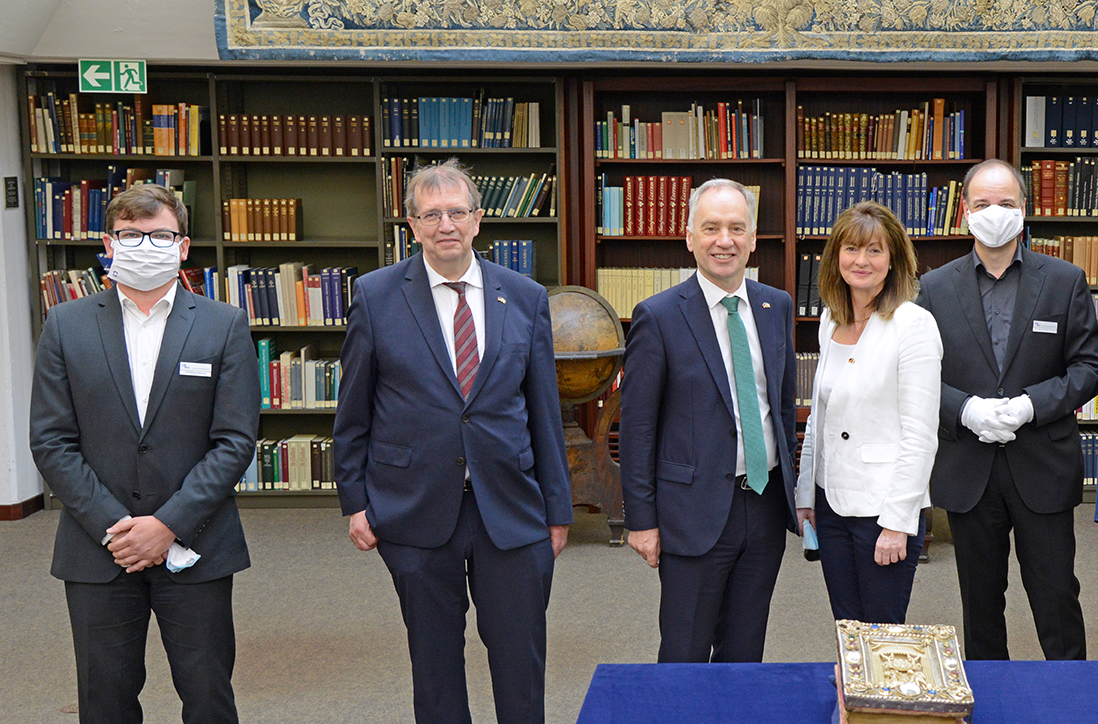
Besuch aus Irland in der Unibibliothek (von links): Christian Malzer, Leiter der Abteilung Handschriften und Alte Drucke, Universitätspräsident Alfred Forchel, der irische Botschafter Nicholas O’Brien, seine Partnerin Mary McCarthy und Hans-Günter Schmidt, Leiter der Universitätsbibliothek. (Bild: Irmgard Götz-Kenner / Universitätsbibliothek Würzburg)
Einige herausragende Zeugnisse der irischen Geschichte gehören zum Besitz der Universitätsbibliothek Würzburg. Kein Wunder also, dass Nicholas O’Brien, seit August 2019 Botschafter der Republik Irland in Berlin, bei einem erneuten Aufenthalt in Würzburg am 17. Juni 2020 auch die Universitätsbibliothek besuchte. Mit dabei war seine Partnerin Mary McCarthy.
Rund 1500 Handschriften aus dem Mittelalter und noch einmal 800 aus der Neuzeit befinden sich in der Handschriftenabteilung im dritten Stock der Universitätsbibliothek. Ein absolutes Prachtstück darunter ist das Kiliansevangeliar, eine Pergamenthandschrift aus dem 6. Jahrhundert. Ihr Vorderdeckel ist mit filigranen Schnitzereien aus Elfenbein verziert, in ihrem Inneren sind auf rund 300 Seiten die vier Evangelien des Neuen Testaments niedergeschrieben.
Die Legende zum Kiliansevangeliar
Das Kiliansevangeliar soll dem irischen Missionar Kilian gehört haben. Dieser brachte der Legende nach im Jahr 686 mit seinen Begleitern Kolonat und Totnan das Christentum nach Würzburg. Hier aber stießen die Mönche offenbar auf wenig Dankbarkeit, denn wenige Jahre später wurden sie ermordet. Ihre Leichen verscharrte man angeblich dort, wo heute das Neumünster steht. Als Würzburgs Bischof Burkhard im Jahr 752 Kilians Gebeine bergen ließ, soll im Grab das Kiliansevangeliar gefunden worden sein.
Diese Geschichte dürfte in der Tat nur eine Legende sein. Wahrscheinlicher ist es, dass das Kiliansevangeliar aus Nordfrankreich stammt, wie verschiedene Randnotizen auf seinen Seiten nahelegen. Wie es nach Würzburg kam, ist unbekannt. Als die Handschrift hier im elften Jahrhundert ihren Prachteinband aus Elfenbein erhielt, war sie am Bischofssitz Würzburg längst in den Rang einer Reliquie erhoben worden. Dementsprechend zeigt der Einband das Martyrium der drei Frankenapostel.
Irische Handschriften des 8. Jahrhunderts
Der irische Botschafter und seine Partnerin waren beeindruckt von dem prächtigen Buch. Präsentiert wurde es von Dr. Hans-Günter Schmidt, dem Leiter der Universitätsbibliothek. Gemeinsam mit der Handschriftenspezialistin Kerstin Kornhoff und dem Leiter der Abteilung Handschriften und Alte Drucke, Christian Malzer, zeigte er den Gästen weitere Handschriften, die aus Irland stammen und ins 8. Jahrhundert datieren.
Da sind zum einen die Paulusbriefe. Deren lateinische Texte enthalten zahlreiche handschriftliche Anmerkungen in altirischer Sprache – das leistete einen großen Beitrag zur wissenschaftlichen Rekonstruktion dieser Sprache. Zum anderen betrachteten die Besucher Teile des Matthäus-Evangeliums. In dieses Werk sind 33 Notiz-Zettelchen mit irischen Namen und Wörtern eingebunden. Diese Handschrift war ebenfalls relevant für die Erforschung der irischen Geschichte.
Irish Studies Würzburg
Der irische Botschafter stattete auch der neu gegründeten Forschungskooperation Irish Studies Würzburg einen Besuch ab. Darin sind verschiedene Bereiche der Julius-Maximilians-Universität (JMU) vereint, die sich mit irischer Literatur, Sprache, Geschichte und Kultur befassen. Die Initiative geht zurück auf Privatdozentin Dr. Ina Bergmann, Forscherin und Dozentin am Lehrstuhl für Amerikanistik, und Professorin Dr. Maria Eisenmann, Leiterin des Lehrstuhls für Fachdidaktik – Moderne Fremdsprachen mit Schwerpunkt Didaktik der englischen Sprache und Literatur.
Die Irish Studies Würzburg sind auch mit externen Partnern vernetzt, unter anderem mit der Deutsch-Irischen Gesellschaft e.V. Würzburg, mit Lehrkräften an Gymnasien und mit der Irischen Botschaft in Berlin. Bei einem Treffen mit Maria Eisenmann begrüßte Botschafter O’Brien diese Kooperation. Er besuchte die Professorin zusammen mit Matthias Fleckenstein, dem Vorsitzenden der Deutsch-Irischen Gesellschaft.
Für das Frühjahr 2021 planen die Verantwortlichen der Irish Studies Würzburg ein feierliches Kick-Off-Event. Für dessen Gestaltung lieferten O’Brien und Fleckenstein wertvolle Anregungen: 2021 wird der 150. Geburtstag des irischen Dramatikers John Millington Synge gefeiert. Ihn könne man beim Kick-Off-Event würdigen, da er im Jahr 1894 sechs Monate lang in Würzburg war und hier auch an der JMU studierte.
See also "Campus Uni Würzburg" 28 (2018)
© Selina Rüb
In summer 2017, a very outstanding experience took place for future English teachers from the University of Wuerzburg and the University of Augsburg. While the seminars on how to teach English to students usually focus on theoretical aspects, we had the chance to combine the theory of planning a class trip with the actual experience abroad and the implementation of what had been planned before.
14 students from the University of Wuerzburg, together with Prof. Dr. Maria Eisenmann, and 11 students from the University of Augsburg, together with Prof. Dr. Engelbert Thaler, wanted to experience Ireland and its culture. Dr. Ina Bergmann, from the University of Wuerzburg, accompanied us as well. With her connections to the Trinity College in Dublin and the University of Galway, and her friendly and welcoming attitude, her participation on the trip was an enrichment for us all.
Before the trip, we did the planning in seminars, each university on its own. We were divided into groups with different responsibilities, and each group had a corresponding “partner group” from the other university. There was a group responsible for history, one for museums, one for culture, one for Trinity College, one for geography and one for Irish writers. The framework of the trip was already given (Dublin and Galway), but we had to fill it with life. Therefore, we did research, planned, booked and prepared the presentations for abroad. As this excursion should not only show us what to do with students in Ireland, but also how to do it, one part of our presentations was to think about the didactic implementation of the content in- and outside the classroom.
End of June we were all set for Ireland. How exciting to soon meet the students from the other university for the first time!
MONDAY: after arriving separately in Dublin, we all met at the Harcourt Hotel in Harcourt Street between 1 and 2 pm. The sooner one arrived, the more time one had for a good Irish Coffee! Good start for a good trip. As soon as everyone had arrived, we set out for our first walk around the town, led by the group responsible for history. The first stop was St Stephen’s Green, a park area quite close to our hotel at the end of Grafton Street. At each stop, there was a short presentation on the facts and stories about each destination. Just the way one could do it with students! The next stop was Dublin Castle – built in the 13th century, it nowadays holds some of the government departments. As we had a lot of stops on our agenda, we hurried on to Christ Church, also known as The Cathedral of the Holy Trinity. It is one of Dublin’s eldest medieval cathedrals, next to St Patrick’s Cathedral. Off we went from there on to the Temple Bar area with the Temple Bar itself, probably the most famous pub in Dublin, and all its other pubs around. During the day, there is not too much going on there apart from the tourists running after a few good pictures of this well-known place, but at night Temple Bar is full of people partying and trying to experience the Irish pub culture. But always keep in mind: when going there with students, it is important to think of the additional benefit such a visit of a pub could have. Quite close to the Temple Bar area, in Grafton Street, there is the statue of Molly Malone – a well-known figure in Dublin, and to foreigners also known thanks to the song by The Dubliners:
“In Dublin's fair city, where the girls are so pretty, I first set my eyes on sweet Molly Malone. As she wheeled her wheel-barrow, through streets broad and narrow, crying ‘Cockles and mussels, alive, alive, oh!’”.
It is not known whether the fictional character Molly Malone is based on the life of a real woman or not. Legend has it that Molly Malone was a fishmonger, who also worked as a part-time prostitute. It is said that she died very young of a fever. The statue is a tourist attraction and many tourists passing by grab Molly Malone’s bosom for luck, so that one can see the bronze wearing off there.
So far, we had only been on the south side of the River Liffey. It divides Dublin into two parts, but there are multiple beautiful bridges between the two parts of the city. Our next stop should have been the so-called GPO (General Post Office), headquarter of the rebels during the Easter Rising of 1916 and therefore an important site for the history of the Republic of Ireland. But the GPO lies in O’Connell Street on the north side of the town. As we had already walked a lot and were quite hungry, we decided to skip that stop and look for a nice pub instead to grab some Irish food and drink a pint of Guinness. We still had two days to go in Dublin!
TUESDAY: after a rather heavy Irish Breakfast with sausages, bacon and scrambled eggs, we set off quite early for the destination of this morning: Trinity College Dublin. Famous people once studied there, including Oscar Wilde and Samuel Beckett. First, we went to one of the modern buildings on the campus, just next to the Library with the famous Book of Kells. In the Trinity Long Room Hub Arts & Humanities Research Institute, we were welcomed by Dr. Caitriona Curtis, the Institute Manager. She explained the tasks of the institute to us:
“The Trinity Long Room Hub offers a world-class research environment that harnesses and expands the excellence of Trinity’s Arts and Humanities research by pioneering and facilitating cross-disciplinary collaborative projects."
She also showed us around the highly modern building constructed in 2010, that received many prizes for its architecture. In one of the rooms, where the researchers usually meet for presentations and conversations, we were allowed to have a presentation about the history of Trinity College and its faculties, as well as the Book of Kells. After some refreshments, we went next door to the Library with the famous Book of Kells. The Book of Kells is an old Gospel book written in Latin and probably created around 800 AD. It contains the four Gospels of the New Testament and is illustrated with many pictures. Unfortunately, one can only see one page at a time, as it is kept in a glass case. Passing through the room with the Book of Kells and up the stairs one can stroll down the Old Library – what a sight! A very high ceiling, shelves on both sides of the long room and statues of important philosophers and writers on both sides…and books, books, books! We were amazed - so many books in such a wonderful place! We saw some German pupils running around with handouts – and immediately thought of the options we would have to bring this place closer to students through different tasks. The idea of this trip was obviously working!
© Ina Bergmann
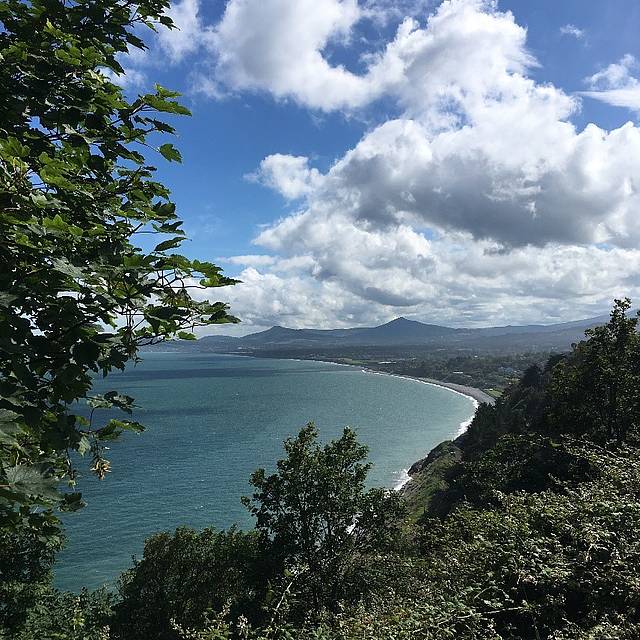
But once again we still had many things to do and see. After a short tour around the campus and some food and drinks, we set off to the Tara Train Station to get the train to Dalkey, which is a lovely little village half-an-hour drive away from Dublin next to the sea. After having rushed through Dublin City, it was nice to escape the hectic city life and enjoy the more rural landscape and some quiet time. And the landscape outside Dublin is outstanding! We walked through Dalkey in the direction of Killiney. There are beautiful houses on the hill, with a great view over Dublin Bay and of course the Irish Sea. It felt Mediterranean, especially because the sun was shining and therefore the wind did not seem so cold anymore. Some brave students even jumped into the cold water, celebrating the ‘Irish summer’. Up the hill we went towards Killiney Hill Park and the Killiney Obelisk. Especially in the end the path got very steep – we were happy to arrive at the top of the hill. The view was breathtaking! Just before the Killiney Obelisk, there was a ‘wishing pyramid’. Of course we didn’t miss the chance to walk up to the top in circles, while looking towards Dublin and making a wish with our eyes closed as soon as we arrived on the top. Dr. Bergmann obviously had a good time taking a video of the line of students climbing up the pyramid. It was much fun! The Killiney Obelisk was built in commemoration of the ‘forgotten famine’ of 1740/1741 due to an exceptionally cold winter. After a short rest, we continued our way down to the village of Killiney to take the train back to Dublin. We were all quite exhausted but very happy to have done this walk.
WEDNESDAY: in the morning we checked out of our hotel and once again made our way to the city. Topic of this morning: Irish writers. Originally, five stops were included in the tour: St. Patrick’s Cathedral with the Grave of Jonathan Swift, the Cú Chulainn statue in the General Post Office, the James Joyce Statue and Mulligan’s Pub, as well as the Oscar Wilde Memorial. However, for it was a very rainy day, we only managed to walk to St. Patrick’s Cathedral, where we listened to student presentations on both Saint Patrick and Jonathan Swift, whose grave is inside the cathedral. From there, across the River Liffey and down O’Connell Street, we walked to the General Post Office. Inside the GPO there is a statue of Cú Chulainn, who is a very important figure both for Irish identity as well as for William Butler Yeats. We heard a presentation about William Butler Yeats and one of his poems there. Furthermore, another presentation on the Easter Rising, that had been planned for Monday, was then given in the GPO as well and illustrated quite nicely how history is always intertwined with culture and reflected in literature and arts in general. After those stops, we walked past the James Joyce statue. However, we didn’t linger there due to the heavy rain, but went straight to the National Museum of Ireland: Archaeology and did that part of our agenda first. In the Museum, we learnt a great deal about Medieval Ireland (1150-1550) and Viking Ireland presented in a very illustrative way, which was both very enlightening and interesting. As to the literary walking tour: the two missing presentations about James Joyce and Oscar Wilde were then given in a dry spot in front of the museum and back in the warm and cosy hotel lobby.
In the afternoon, we collected our luggage at the hotel and took the bus to Heuston Station, from there we took the train to Galway. Many of us had an extended nap on the train – sightseeing during the day, much information to take in and not to forget a pint or two of Guinness every night had made everyone tired. Three hours later we got off the train in Galway and made our way to the hostel by foot. Sleepzone – the name of the hostel was very welcoming to us! Food, drinks, a bit of rest: at 7 pm half of our group met to go to a musical called Misé Éire – I am Ireland at the Black Box Theatre Galway. After a short introduction to some famous Irish tales and legends, we dived into a very special “Irish Experience”: accompanied by fiddle, harp, Irish flute and step dancers, we could emerge into the Irish history from the pre-Christian times till the Proclamation of the Republic of Ireland. From Grace O’Malley, the “Sea Queen of Connacht”, to the story of how Cú Chulainn, an Irish hero and warrior of the pre-Christian time, got his name (meaning “Hound of Chulainn”); from the story about the Claddagh Ring (a well-known symbol that stands for love, friendship and loyalty) to the Great Famine and the Emigration to the New World in the middle of the 19th century; and from there to the Easter Rising of 1916, the Proclamation of the Republic and finally, Ireland’s independence from the United Kingdom. The musical showed the pride of the Irish in their country and their culture. We all enjoyed the musical very much as it summarized many of the places and stories we had seen and heard the days before in Dublin. We decided that it would be worthwhile to go there with students as well – provided with the right tasks, they could learn much about history and culture in a very entertaining environment.
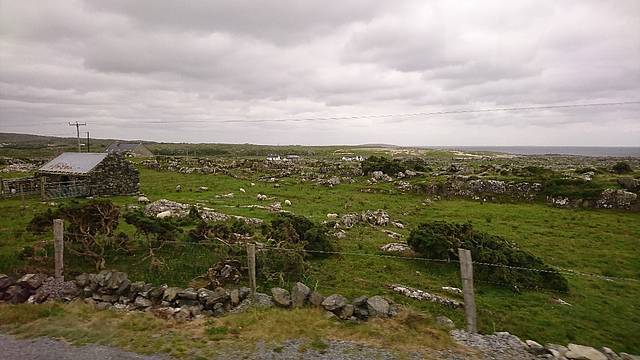
THURSDAY: It was time for nature and the coast again. We had a private coach plus driver who took us through the great scenery of the Connemara National Park. Our tour started in Galway at 10 am. Connemara is an area located on the western coast of Ireland where the Irish language is predominately spoken. The rural area has an incredible landscape to offer. We were overwhelmed by the diversity of hidden lakes, mountain ranges, wide beaches and rocky ground. First stop was Kylemore Abbey, a castle reminding us of fairy tales. It is located next to a small lake and has a beautiful Victorian walled garden. Afterwards we drove to a cute little fisher village to get lunch there. It was windy and cold outside, but this fact did not bother us anymore after a few days in Ireland! We continued our journey after an hour, as we still had quite a few kilometres to go on small and bumpy roads. On the way we got the chance to see more of the beautiful shore of the Atlantic Ocean. After a while we stopped again at a breath-taking beach to dip our feet in the water and to take more pictures. But the sky was very cloudy and from time to time it was raining, so we decided to drive back to Galway.
In the evening, before we set out for our pub crawl, we had a little practical activity outside our hostel. We danced an Irish folk dance called Bridge of Athlone. Everyone had to choose a partner and then we lined up, men facing women. And off we went! Forward, two, three, bow; back, two, three, four. Swing your partner with the right arm, swing your partner with the left arm. And now the first couple dances down the aisle! And back up again! And everyone follows, the first couple makes a bridge, and everyone passes through into their new position. And from the start! Forward, two, three, bow…after five minutes of dancing and laughing and stepping on each other’s feet from time to time everyone was exhausted, but one couldn’t see a face without a smile on it. Dancing is freeing up emotions and bringing cultures together in a unique way.
After the dance, we went to a few pubs in Galway. On the bus and back in the hostel we had heard presentations about Irish Traditional Music, also called Trad Music. As Galway is a very touristic place, one can find many pubs offering live music every night. But it was hard to find a pub with space for around thirty people, so the group soon split and everyone looked for their own pub crawl. Some of us went to a pub called O’Connor’s, where Ed Sheeran shot part of the video to his famous song Galway Girl: “She played the fiddle in an Irish band, but she fell in love with an English man…”
It was a good night out!
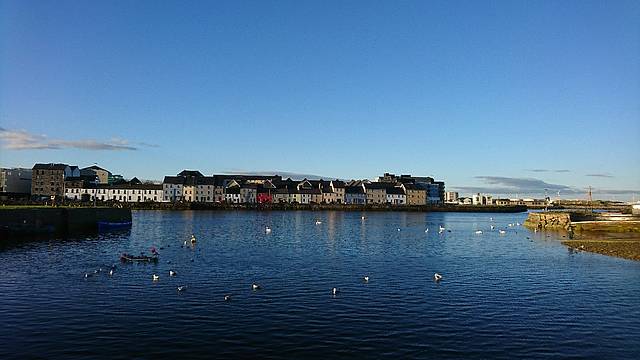
© Selina Rüb
FRIDAY: in the morning we headed out for a Galway city tour. Not only did we just walk around the beautiful town, we also grouped up and tried to answer all the questions of a rally that was especially made up for the tour around Galway. We started at Eyre Square, a small park area close to our hostel. It is also known as John F. Kennedy Memorial Park, as the president of the United States gave a speech there during a trip through Europe. Walking down the pedestrian zone with its little shops and street musicians we passed Lynch’s Castle, a medieval limestone building. It was home to the Lynch family, one of the most powerful families of the area at that time. Afterwards we stopped at St Nicholas church. Legend says that Christopher Columbus once worshipped there. Following the direction of the coast we reached the Galway City Museum, that provided us with additional information about Galway and its past. Next to the Museum one can still see the Spanish Arch, which is part of the old wall around the town and is known as a former fish market place. Passing the river Corrib we reached the Claddagh, which means “stony beach” in Gaelic. It is one of the oldest former fishing villages in Ireland and has been recorded since the arrival of Christianity in Ireland in the 5th century. During the Great Famine, many of its inhabitants left, especially the young men. Next stop: Nora Barnacle house – the place where James Joyce’s wife grew up. Unfortunately, the little museum inside was closed that day. A bit further on we walked over the Salmon Weir Bridge and came to the Galway Cathedral. Time for some lunch! An hour later we all met again at the Cathedral – those of us who had been there earlier could even watch an Irish wedding happening there! Our last stop was the National University of Ireland, Galway, where we got the chance to listen to Dr. Erin A. McCarthy as she explained her research project RECIRC: The Reception & Circulation of Early Modern Women's Writing, 1550-1700:
“RECIRC is producing a large-scale, quantitative analysis of the reception and circulation of women's writing from 1550 to 1700. The results will enable analysis of how texts, ideas and reputations gained traction in the early modern period."
Dr. McCarthy is one of ten female researchers concerned with this project.
After showing us around the mosrn campus, Dr. McCarthy led us to the oldest part of the university, the historical Quadrangle Building from 1849. The sun was shining, some students lay on the grass reading a book – the University of Galway seems like a very good place for studying!
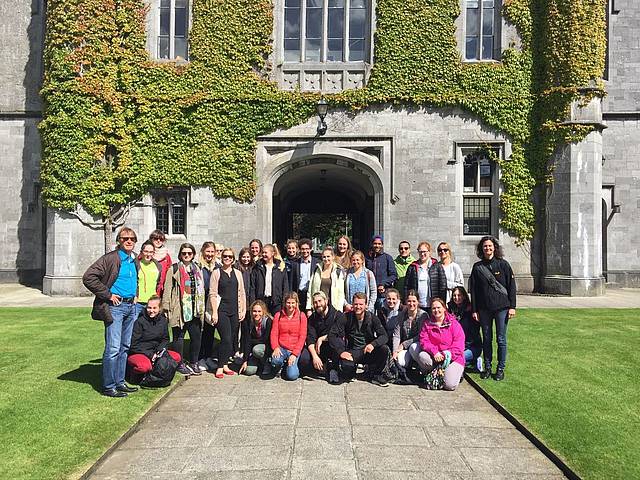
© Deborah Metzlaff
As it was our last evening, we decided to have dinner together at the famous “King’s Head” pub restaurant. Irish food and once again a pint of Guinness – a decent end for a very informative and enriching trip!
All in all, the participants in this excursion got along very well, which contributed to an utterly pleasant and learning-friendly social environment, beneficiary for everyone: thanks to the informative presentations prepared by the students and the outstanding organizational contributions by Dr. Bergmann and, most notably, Prof. Dr. Eisenmann, we learned a fair deal about life on the Emerald Isle: We became acquainted with its culture, literature, music, language, history and the geography of both its rural and urban areas. The knowledge gained in the seminar and during the excursion forms the basis of one day planning a class trip to Ireland ourselves.
In the name of the group, we would like to thank everybody who made The Irish Experience as stunning and unforgettable as it was!
Prof. Dr. Maria Eisenmann, Michelle Zirkel, Lisa Jaretzke, Deborah Klein
Testimonials
I am very thankful for the opportunity to attend Guest Lectures on various interesting topics, I do enjoy them every time. I particularly enjoyed the Guest Lecture by Prof. Kate-Sullivan on the book 'Long Island' by Colm Tóibín. I have read the book for a Seminar in Irish American literature and I really enjoyed the deeper look into the work with Prof. Costello-Sullivan. She is an expert on the writing of Tóibín and gave us many more aspects to pay attention to, when reading his works. Her interpretation of the book was extremely interesting to hear and I really benefited from her additional information and her perspective on the novel as an expert of the author's general canon. All in all, it was a really enjoyable and beneficial lecture and gave me a deeper insight into the novel and its context. Thank you very much, I am looking forward to the next Guest Lecture!
Sophie Stangler, student of English and American Studies, University of Würzburg
As a Ph.D. candidate working on the contemporary Irish novel, I am very grateful to have had the opportunity to attend Prof. Kate Costello-Sullivan's illuminating lecture on Colm Tóibín's latest novel, Long Island. Prof. Costello-Sullivan's fascinating insights into the intertextual layers of the novel – particularly its connections with Tóibín 's other works, most notably Brooklyn – and her analysis of the intersections between cultural place and the formation of gender norms, as well as the in-betweenness of cultural identity, have greatly inspired me. Thank you so much for organizing such a thought-provoking event.
Ceren Turan, Ph.D. Candidate, Ege University Izmir
I really enjoyed the lecture. It was a refreshing change to look at the authors not just as writers but also as photographers! It was super interesting to see how their photos connect to their literary work and how each of them approched visual storytelling in such a personal and unique way. I especially liked how Prof. Paige Reynolods drew comparisons between those three artists, even though they come from very different backgrounds and time periods. It helped me think of photography as type of narration itself, not just as add on to a text. Overall, it was a thoughtful and visually engaging lecture that made me appreciate photography even more!
Theodora Popov, student of English and American Studies, University of Würzburg
As a camera enthusiast myself, I really enjoyed the J.M. Synge lecture. Besides the comparison of the authors' texts, I truly enjoyed the juxtaposition of their photos and also the equipment they used in their time periods. And I liked the modern equivalent, Luis Alberto Rodriguez, whom I am now following on social media.
Tim Adam, student of English and American Studies, University of Würzburg
We know J. M. Synge as one of Ireland’s most important playwrights but he was also a pioneer of photography. It is fascinating to see the parallels of his perspectives as an author and a photographer, focussed on rural scenes and individuals in Wicklow and in the West of Ireland. Thrilling to hear about similarities in the work of Eudora Welty, her photos also reflecting her literary ideas. Synge and Welty were both characterized by a deep attachment to the people and landscapes represented in their work, and this year’s J.M. Synge lecture was an inspiring talk stimulating further thoughts. I enjoyed it very much, many thanks to Paige Reynolds for this lively and dedicated impulse, and to the team of Irish Studies Würzburg for organizing this talk!
Matthias Fleckenstein, Chairman, German-Irish Association of Würzburg
I took part in the guest lecture held by Prof. Éammon Ó Ciardha and I really appreciated his presentation. I was not familliar with the Irish TV show "Father Ted" prior to the lecture, but I really enjoyed his explanations and comparisons. I thought it was extremely interesting to hear his personal anecdotes about the situation of the Catholic Church in Ireland. His presentation of the difficulties of the Irish Catholic church in combination with the analysation of the TV show, made for a very entertaining and informative lecture. I really enjoyed hearing Prof. Ó Ciardha talk today! Thank you very much for the opportunity to attend those lectures, I am looking forward to the next one!
Sophie Stangler, student of English and American Studies, University of Würzburg
The author reading by Helen Cullen about her book The Truth Must Dazzle Gradually was a great experience for me. The opportunity to ask an established writer questions is rather rare - therefore, I am thankful that we had the chance to do so. I especially enjoyed listening to Helen when she told us about her struggles as a young writer. I found her thoughts about writing very inspirational and encouraging. I think that often, authors are some out-of-reach characters for us, which is quite sad. The author reading made it possible to reach out and connect and I would certainly visit an author reading again!
Anna Lena Seitz, student of English and American Studies, University of Würzburg
Helen Cullen's author reading from her novel The Truth Must Dazzle Gradually was a brilliant mix of reading, discussion and introduction to context and her thoughts. Her novel was one of the most delightful, yet moving texts I read for a class in a long time and I enjoyed being able to connect the novel to class content. Cullen took us on a very personal journey of her life and her writing process, leaving an equally emotional imprint on me as her novel did. Thank you for the lovely event, I cannot wait for the next author reading!
Lea Fröhlich, student of English-Speaking Cultures, University of Würzburg
Reading good books and discussing them with interesting people is always special, but the author reading with Helen Cullen on The Truth Must Dazzle Gradually made the experience with the book truly extraordinary. Helen Cullen's insights on her writing process as well as her personal connections to the book unlocked a new rich layer of understanding Irish literature and culture, making the event both inspiring and memorable.
Elisa Raab & Laura Maier, founders of A Little Book Club, University of Würzburg
Brian Ó Conchubhair and Samuel Fisher’s workshop on Irish poetry gave me valuable insights into a field of studies in which I had no prior knowledge, and I thoroughly enjoyed learning about their latest anthology and the process of creating it. As an aspiring teacher myself, I found it particularly interesting to hear about their approaches to teaching Irish poetry and the challenges that come with it.
Felicia Folmers, student of English and American Studies, University of Würzburg
I really enjoyed Brian and Samuel’s workshop. The workshop gave really interesting insights into the world of Irish language poetry and its link to the Irish state, its culture and history. As I have already studied the history of the Irish language in different contexts, I found the role of the Irish language in poetry particularly interesting - especially how it was used to exclude certain groups of people - even though Irish was the oppressed language. Thank you so much for the informative workshop!
Merle Möllers, student of English and American Studies, University of Würzburg
Brian Ó Conchubhair and Samuel K. Fisher's worskhop "When Poems and History Rhyme: the Politics and Poetics of the Irish Poetic Tradition" was an incredibly insightful event to learn about both the longstanding tradition of Irish poetry and, something we as students do not necessarily have on our radar, the challenges of publishing an anthology, regarding contributions as well as the intended audience. I particularly enjoyed the interdisciplinarity of the project and how their anthology makes clear that Irish poetry does not automatically equal poetry from the island of Ireland. It was impressive to see how poetic traditions have changed and are changing and that new modes of delivery in the 21st century implicate a revival of oral performances. Thank you for this great event!
Lea Fröhlich, student of English-Speaking Cultures, University of Würzburg
I enjoyed this thought-provoking guest lecture and would like to thank Professor Anne Fogarty for sharing her insights and vast knowledge of these important writers. Also thank you to the organising committee, for arranging this online so I could be part of this stimulating event.
Deirdre F. Brady, Lecturer of Education, Mary Immaculate College Thurles/Limerick
I participated in the guest lecture given by Prof. Fogarty and I enjoyed the lecture. Generally, the opportunity to attend a lecture given by a professor from Ireland is very beneficial and a great chance to experience a more in-depth analysis of Irish literature. The lecture was really interesting, especially because Prof. Fogarty was clearly an expert on the topic and I quite enjoyed listening to her. It was great to hear more about authors most people only know the names of and maybe one of their most famous works and to listen to the Professor's takes on their works and their relationships with each other. The lecture really highlighted the importance of Synge, Joyce, and Ibsen and how they shaped theater. I am really grateful to have had the opportunity to participate and I am looking forward to any upcoming guest lecture in the future!
Sophie Stangler, student of English and American Studies, University of Würzburg
Congratulations to ISWÜ for all the great work I have been following in the past few months. Listening to Prof Fogarty was as pleasant as it was informative. I participated in James Joyce Summer School Dublin; this time, Joyce's relation to Modernism, Synge, and Ibsen was another exciting and great talk. I am looking forward to the upcoming events and talks!
Maryam Najafi, Assistant Professor of English and American Literature, Haliç University Istanbul
I'm glad I got the opportunity to attend Prof. Anne Fogarty's intriguing lecture "Inventing Modernism: Synge, Joyce and Ibsen" to gain a deeper understanding of the three authors, their works and their connections with each other. I found it exceedingly enriching to hear directly from a professor at University College Dublin and hope for many more events of this kind! Many thanks to Prof. Anne Fogarty and all those involved in organizing the lecture!!
Amelie Kubach, student of English and American Studies, University of Würzburg
The symposium has been a unique opportunity to dive deeply into the manifold meanings that imagined animals in Irish literature carry. The conjunction of literary animals and real animals, i.e., viewed from a cultural studies perspective, has been immensely beneficial for a greater understanding of how Irish identity and animals are entangled.
Dilâra Yilmaz, PhD researcher English Literature, Kiel University
I would like to congratulate you for organizing a wonderfully stimulating and convivial conference.
Síle Ní Mhurchú PhD, Senior Lecturer and Head of the Department of Modern Irish, University College Cork
I immensily enjoyed the ISWÜ Symposium "The Animal in Ireland, Real and Imagined". The symposium was perfectly organised and brought together a variety of scholars from different research areas. The reading, the talks and the keynote lectures were very thought-provoking and I would like to highlight the high quality of all the contributions by established as well as emerging scholars. Besides, I would like to thank all organisers and participants for the great atmosphere and the interesting discussions!
Dr. Alessandra Boller, Faculty of English Literary and Cultural Studies, University of Siegen
I very much enjoyed this symposium—it was marvelously interdisciplinary, and thought-provoking, Many, many thanks!
Kate Costello-Sullivan, Professor of Modern Irish Literature, Le Moyne College
Thoroughly enjoyable and very welcoming time at The Animal in Ireland this week! Very thankful to have been awarded a travel grant to attend with Pearse. I look forward to returning to Germany. Go raibh míle míle maith agaibh a chairde!
Maureen DeLeo, PhD researcher School of English, University of Galway
The organization of the symposium was absolutely perfect. Congratulations.
Laurent Daniel, Lecturer English and Applied Languages, University of Southern Brittany
Maureen O'Connor's guest lecture "Haunted Nature in the Fiction of Edna O'Brien" was a perfect introduction to the works of one of Ireland's most brilliant women writers as well as to the connections between Irish history and its folklore, religiosity, its people, and their connection to the nature. I also particularly enjoyed the insights on Edna O'Brien’s biography and the consequences her "insider-outsider perspective" had for her life as an author. As a student in Maureen O'Connor's seminar, it was a pleasure to be able to draw solid connections to the other works read in class and to deepen the knowledge we have already gained during the semester. Thank you for the great event!
Lea Fröhlich, student of English-Speaking Cultures, University of Würzburg
The talk about Edna O'Brien by Maureen O'Connor was truly inspiring! Even though I read O'Brien's novel In the Forest, I, unfortunately, did not know anything about her as a person and her background. Hearing Maureen O'Connor talk about Edna O'Brien made me appreciate and understand her fiction in new ways. Moreover, it is always inspiring to learn more about a woman who had such a great impact on the literary world. Thank you so much for organizing this great event!
Elisa Raab, student of English-Speaking Cultures, University of Würzburg
Guest lectures are always a much appreciated opportunity and Dr. Maureen O’Connor’s talk on "Haunted Nature in the Fiction of Edna O'Brien" was no exception to that. With just the right amount of information on Edna O’Brien and a deeper dive into her work "In the Forest", I as attendee was able to appreciate O'Brien's literary legacy in a more profound way. Thank you for organizing this very inspiring event!
Laura Maier, student of English-Speaking Cultures, University of Würzburg
On November 30, 2023, I had a perfect opportunity to attend the ISWÜ Guest Lecture "Haunted Nature in the Fiction of Edna O'Brien" by Prof. Dr. Maureen O’Connor (University College Cork/University of Würzburg). This event was very remarkable for me because it made me think about human self-identity formation influenced by the natural surroundings, haunted myths, and spirits, which have always accompanied my self-identification and development in the transnational context. Prof. Dr. Maureen O’Connor has inspired me to draw parallels between natural and unnatural, feminine and masculine, as well as think about the importance of finding one's perfect place in life. Thank you, dear ISWÜ Team, for this fantastic event!
PD Dr. Nataliia Lazebna, TEFL Methodology, University of Würzburg
I truly enjoyed our excursion to Dublin and Cork. I already arrived a few days prior with other students which gave us time to do our own sightseeing and buy some souvenirs - later on I didn't always find time to do so due to our strictly planned program. The hike to Bray Head with breathtaking landscapes and the Literary Pub Crawl - which we won as a group - were my personal highlights in Dublin. Not only did I like the many museums we visited, I appreciated spontaneous group activities as well, such as singing songs on the rooftop terrace of our accomodation on a warm Dublin summer evening or cooking dinner in Cork. What surprised me the most was the play Every Brilliant Thing in the Abbey Theatre. At first I didn't know what to expect, in the end it was entertaining, funny, and moving at the same time. The second surprise were the adorable houses in Cobh and I was happy to go there as I had been wanting to visit the Titanic Museum for a long time. Some days were really exhausting which is inevitable when you plan on doing 3-4 activites each day, but we gained such an insight in Irish culture, history, nature, and the infamous Irish weather that it was totally worth it. Therefore I want to thank everyone who made the field trip such a fun and unforgettable experience!
Natascha Holstein, student of English and American Studies, University of Würzburg
The field trip to Ireland was my first excursion with Uni due to Corona and it was a success.The first days in Dublin were filled with great experiences of which I wouldn’t have wanted to miss a single one. From various museums to a very funny Literary Pub Crawl we did almost everything worth doing in Dublin including hiking alongside the coast in just 3 days. On long bus ride from Dublin to Cork I was given a privat “Tour” from a local, called John. He told me about important buildings and places we drove by and told me many interesting facts about his home, Ireland. This encounter confirmed just once more that the Irish are indeed very welcoming and incredibly kind. Our days in Cork were really entertaining too, we visited an old Prison and went to the Titanic Museum. With almost 27.000 steps on the last day we ended the official part of our excursion with a delicious meal at a restaurant and a few drinks in a local pub.Thank you to professors Eisenmann, Bergmann and Leitner for an incredible “Irish Experience”!
Laura Baumann, student of English and American Studies, University of Würzburg
On the one hand, the field trip was informative and helpful for my current studies and on the other hand, it was a nice experience that led to new friendships and stories to tell. Ireland offers great landscapes. We could immerse ourselves in the Irish world for the perfect “Irish Experience”. The literary pub crawl was a nice way to get to know something about the literary history of Ireland, and further to get to know people and try different pubs. The field trip was the perfect mix of culture, education and fun. Thank you for the amazing experience!
Anna Centner, student of English and American Studies, University of Würzburg
I found Deirdre Kinahan to be an extremely inspiring woman and I thoroughly enjoyed hearing about her career as a playwright. You could tell how passionate she is about representing marginalised groups in her plays and providing a realistic image of life in Ireland that doesn't gloss over topics such as sexual assault. It was also really interesting to get an insight into theatre in Ireland and the differences to Germany, especially regarding funding. Thank you so much for the entertaining and informative workshop!
Felicia Folmers, student of English and American Studies, University of Würzburg
The ISWÜ-event was an ideal opportunity to gain some insight into various aspects of Ireland’s history and politics. Dr. Wall’s lecture was really enlightening, with plenty of information about the Irish diplomatic relations, its challenges and developments through the years. It was interesting to learn more about Ireland’s foreign policy as a “small island state” and the membership of the European Union and the Irish-German relations. Thank you for the great event!
Chrysoula Perathoraki, student of English and American Studies, University of Würzburg
Dr. Wall’s guest lecture gave a comprehensive overview not only of Ireland’s foreign policy, but also of its economic policy. I especially enjoyed learning more about the importance of foreign relations as a small island state as well as the economic boom Ireland experienced in the mid 1990s due to the Celtic Tiger. Furthermore, it was interesting to gain some insights into how Ireland and especially Northern Ireland are affected by Brexit.
Isabell Traub, student of English and American Studies, University of Würzburg
Seamus Deane, an outstanding writer and critic, rooted in his home town Derry and known as a poet, novelist, and scholar, one of the "Boys of St. Columb's" and one of the founders of the Field Day Theatre Company. I really enjoyed being introduced to so many facets of his life and work, some of them well known, others new to me. Many thanks to Maurice Fitzpatrick for this really inspiring approach to the person Seamus Deane, his work and contemporaries!
Matthias Fleckenstein, Chairman, German-Irish Association of Würzburg
I did encounter new ideas. I really enjoyed reading the essays we were asked to read beforehand and getting a different perspective regarding the immigration to Ireland as well as a sense of "strange encounters".
Katharina Beutner, student of English and American Studies, University of Würzburg
I received interesting insights, thank you. We should perhaps reflect more on the differences between the nineteenth-century immigrants and those in the twentieth.
Prof. Dr. Jochen Achillles, former Chair of American Studies, University of Würzburg
What I found really interesting is the opera adaptation of This Hostel Life. It made me think of different ways in which important issues can be introduced to different audiences.
Elisa Raab, student of English and American Studies, University of Würzburg
Thank you for an engaging seminar! I particularly enjoyed the selection of material discussed and the connection to life-writing.
Victoria Allen, PhD student, University of Kiel
I did come across ideas I hadn't thought of yet. I will especially continue thinking about the concept of strangers.
Teresa Ó Dúill, student of English and American Studies, University of Würzburg
I really enjoyed the guest lecture “Northern Irish Songs in the EFL Classroom” by Michelle Zirkel (University of Bamberg, Germany). It was very refreshing with many opportunities to participate. Since Ireland is included as a topic in the curricula (Lehrplan PLUS), it was very helpful to learn different and creative teaching ideas of how to integrate Northern Irish songs into the classroom. Thank you Michelle Zirkel for the interesting lecture and the great variety of different Northern Irish songs! I also want to thank Irish Studies Würzburg for organizing this event.
Karina Mößle, student of English and American Studies, University of Würzburg
Dear Irish Studies team, I want to thank you for the interesting author reading OK, Let's Do Your Stupid Idea. Patrick Freyne gave a very personal insight into his work as well as into the process of writing itself. The reading was vivid and interactive and Patrick Freyne has an extraordinarily inspiring personality. I am thankful for having had the chance to be part of this entertaining and insightful author reading.
Lea Müller, student of English and Spanish Studies, University of Würzburg
Patrick Freyne‘s author reading was a very valuable experience. His reading of selected passages elevated my appreciation of his book OK, Let‘s Do Your Stupid Idea even further. It also turned out to be a great opportunity to ask all the questions that came up in my reading of his book. I want to thank Irish Studies Würzburg for this opportunity and hope to be able to attend future events.
Dominik Kraus, student of English and American Studies, University of Würzburg
Monica Brandis´ Vortrag hat dieses nahezu vergessene Kapitel des irisch-deutschen Miteinander so nahe am Ende des Zweiten Weltkriegs nach oben gebracht. Selbst im Rahmen der deutsch-irischen Commuity gibt es kaum Kenntnis dazu.
Leider ist es so, dass durch den großen zeitlichen Abstand die Zeitzeugen dieser Operation in der Regel die 80 überschritten haben und es abzusehen ist, dass es in einigen Jahren gar keine von Ihnen mehr geben wird. Es wäre schön, wenn Frau Brandis die Gelegenheit bekäme, Ihre Forschungen hierzu weiter zu vertiefen.
Einerseits war es schade, dass er nur „online“ dargebracht werden konnte, da so der direkte Kontakt zu einem Publikum fehlten. Andererseits konnten auf diese Art und Weise auch zusätzliche Interessierte daran teilnehmen.
Hier noch einmal meinen großen Dank an Irish Studies Würzburg für diese Veranstaltung. Mein großer Dank geht natürlich (und nicht zuletzt) auch an Monica Brandis, die in mühevoller und zeitaufwändiger Kleinarbeit diese Kapitel der Menschlichkeit erarbeitet und hervorragend präsentiert hat.
Peter Dietsch, ehemaliger Präsident der Deutsch-Irischen Gesellschaft in Bonn
This is a little-known chapter of recent Irish history: “Operation Shamrock“, initiated by Dublin paediatrist Dr. Kathleen Murphy, started when Europe was in ruins after World War II and aimed at supporting traumatised German children by providing temporary care for them in Irish families. Monica Brandis followed the children’s traces and contacted a considerable – and still growing – number of them. She curated an impressing exhibition of portrait photographs with biographic notes of the former “Children of Operation Shamrock“ in order to let them tell their stories. The exhibition has been displayed at a number of places both in Germany and Ireland, including the Würzburg Town Hall in 2017. Many thanks to Monica Brandis who gave us a very personal and touching approach to the children’s experiences and stories in her talk!
Matthias Fleckenstein, Chairman, German-Irish Association of Würzburg
The talk by Monica Brandis opened a window onto a different Irish world for me. I was aware of Germans who fled the Nazi regime, and came to Ireland, but not of this 1946 operation sending 450 German children from North Rhine-Westphalia to Ireland to stay with Irish families. It was poignant to learn the children’s individual stories, and shocking to hear that there was neither vetting, nor a systematic follow-up with the families. What those children experienced and remembered was down to individual luck, and sometimes even to individual looks. In general children in need can count on help, but inevitably, there will be misunderstandings with their benefactors, and clashes of lifestyles, personalities, or expectations. Although Operation Shamrock happened 76 years ago, experiences of wartime displacement are universal, as we see today, with refugees seeking shelter in the EU again. So, Monica Brandis’ interviews can teach us a lot today. While going about our daily business, we might meet people who have gone through similar experiences, and Monica reminded us of that.
Beatrix Faerber, CELT Manager and Editor, University College Cork
For me, the integration of literature into TEFL reminds me of unwrapping a colorful piece of cloth. Narratives of authors from different parts of the world are bright accents on this background of literature masterful pieces created. Broadening the horizon of our students, modern teachers appeal for their critical thinking and analytical processing of knowledge gained. Irish Studies for me is something new and mysterious, mythical and urbanistic, a tiny thread, which knits a global patchwork decorated with historical narratives and puts the present in a critical perspective through lenses of the past.
PD Dr. Nataliia Lazebna, TEFL Methodology, University of Würzburg
Although I was a bit disappointed when hearing that the symposium would take place online, I very much enjoyed it either way with many cups of tea at home. Listening to so many different approaches over a short time span was admittedly demanding but also very much broadened my view on the subject. I likewise noticed the informal and welcoming atmosphere in the room amongst those who were present and I am very much looking forward to taking part in a purely face-to-face symposium sometime!
Marie-Isabell Hennicke, student of English and American Studies, University of Würzburg
I really enjoyed the style of presentation of Prof. Hickey’s talk. He managed to present historical-sociolinguistic research procedures and findings in a very approachable way. Original audio files as well as some captivating personal stories were seamlessly incorporated, and turned the talk into a memorable experience. In addition, the organizers are to be applauded for enabling the hybrid (Zoom/live-on-campus) format.
Dr. Patrick Maiwald, English Linguistics, University of Würzburg
Working with historical data is as a much a challenge as an opportunity and with his fascinating talk about ego documents Prof. Hickey managed to illustrate exactly that. He was able to show how sociolinguistic research can provide insights into the socio-historical background of Irish immigrants in an interesting and comprehensible way without distorting the limitation of such approaches. I would also like to thank the organisers for offering a hybrid format which allowed me to attend the guest lecture online.
Lisa Lehnen, English Linguistics, University of Würzburg
This thrilling lecture is ever inspiring. Its integral nature, which combines both literature excerpts, relevant flashbacks of the lecturer and critical interpretation of Prof. Dr. Patrick Lonergan (NUI Galway, Ireland) introduces the world of John Millington Synge brilliantly. Relevant correlations between literature heritage of the author enriches perception of the readers and outlines further possible interpretations of the writer's works. There is always a way for global melting pot and a will to get the best multifaceted intellectual product.
PD Dr. Nataliia Lazebna, TEFL Methodology, University of Würzburg
This was wonderful and absolutely incredible. I’m writing a senior thesis on Irish Environmentalism, and this made me even more excited to start researching, exploring, and writing!
Emma Yakscoe, Saint Joseph’s University, Philadelphia, Pennsylvania, USA
I was very pleased by the lecture by Prof. Dr. Lonergan. Especially the combination of photos and text and quotes were illuminating to me. Thank you for letting me have that online experience.
Moni Reinwand, Fürth
This lecture on John Millington Synge by Prof. Dr. Patrick Lonergan was brilliant and fascinating. I was previously unfamiliar with J.M. Synge's works but the informed and insightful commentary helped to really dive into his world. Especially the perspectives on Irish culture and its connection to matters such as global warming were thought-provoking. I will definitely remind myself of this lecture and its approaches in the future.
Dominik Kraus, student of English and American Studies, University of Würzburg
For all friends of Irish films Prof. Dr. Lance Pettitt's lecture "Irish Cinema: A (Short) Screen History" provided a concise and valuable overview of a century of films and filming. A variety of facets like films in the Irish language, American productions filmed in Ireland, (early) documentaries and feature films, period films produced with different backgrounds - both Irish and British - and TV productions but also a bit of social history of cinemagoing were presented in a very attractive way including a few film clips as practical examples. I really enjoyed this inspiring lecture, it made me look forward to my next Irish film. Würzburg's Irish partner region of Wicklow is a centre of Irish film with two major studios - Ardmore in Bray and Ashford Studios - where productions like Braveheart or more recently The Tudors or Vikings were filmed. And Irish films are regular features at Würzburg's Filmwochenende, so what would suit better than a lecture about Irish Cinema?! Many thanks to Prof. Pettitt for this enjoyable afternoon!
Matthias Fleckenstein, Chairman, German-Irish Association of Würzburg
I thoroughly enjoyed Prof. Dr. Pettitt´s insightful talk on Irish cinema and its history. What really struck me was the degree to which Ireland and especially its cultural image - after centuries of British rule and colonialism - actually continued to be shaped and determined by other (bigger) countries like the U.S. on the movie screen, with the first Irish film studio opening only in 1958. Considering this history and its implications, it doesn´t seem surprising that Irish cinema is still grappling with questions of national identity as we have seen through the multiple movie examples given during the talk, e.g. with "Yu Ming Is Ainm Dom" (2003). It seems to be much like Irish director Jim Sheridan pointed out: “Identity, identity, identity. It’s like a mantra in this country. I think the real reason we’re so concerned about identity is because we’re worried that we haven’t got one.” I definitely have a few new movies on my what-to-watch-next-list now.
Anne-Sophie Hornung, student of English and American Studies, University of Würzburg
In the dark of our second pandemic winter, ISWÜ called us together to consider ecopoetics with Maureen O'Connor, and the workshop's bounty was rich and nurturing. Spending time among like minds drawn from different disciplines to contemplate big ideas and beautiful words is one of the unique joys of academic life, and I am deeply grateful to the ISWÜ team and to Maureen O'Connor for bringing us together in this way to nourish new possibilities for the environmental humanities, for Irish Studies, and for our own work.
Hannah Nelson-Teutsch, M.A., PhD candidate, Graduate School of the Humanities, University of Würzburg
I quite enjoyed listening to Prof. Coleman's presentation on the topic of "feline form". As a cat lover myself I found it fascinating how much more there is behind the term "cat". The presentation showed how much poets interacted with each other in the past, sending out secret messages to each other or positioning themselves in a hierarchy of poets. It also vividly showed us how much the real world is intertwined with the world of poetry.
Luca Machacsek, student of English and American Studies, University of Würzburg
I really enjoyed participating in this online event. I liked the organization of listening to and joining the discussion with four individual lecturers. All of them gave a concise impression of their presented topics. In particular, the comparison between Irish and Eastern German identity constituted a new viewpoint to me. It expressed that, although we are living in different cultural areas, we can still experience very similar events. Also concerning the talk about St. Patrick, I reconsidered for myself that one individual does not necessarily hold only one identity. It is the places and people that characterize one's identity and culture. These impressions were also confirmed by the talks about the novels ''TransAtlantic'' and "Brooklyn". Thanks to all lecturers for the very instructive and interesting day!
Anke Pickert, student of English and American Studies, University of Würzburg
I enjoyed the study day. It was an interesting event with a lot of opportunities to gain new knowledge about different aspects of Irish studies. The speakers presented the topics clearly and illustrated their effects on modern times. The wide range of topics was especially great.
Rupen Kaupert, student of English and American Studies, University of Würzburg
The Study Day "Journeys Across the Waves: Discovering Irish Identity" offered multiple texts and topics for us to engage with and learn about. In particular, the lecture on Derek Scally's The Best Catholics in the World and the entailed conversation about memory culture and its importance and difficulties were insightful elaborations on different possibilities of dealing with the past as well as the necessity to do so. More generally, however, the diversity of perspectives and knowledge brought to us through the four presentations and discussions built an event that nicely illustrated the interconnectedness of the topics discussed as well as the richness of adjunct themes and approaches these topics (and Irish Studies in general) have to offer. Lastly, I think it is worth mentioning how the four-part structure allowed us to sit back and listen to one section and engage a bit more actively with another, thus giving everyone a space to participate depending on their individual interests or knowlegde.
Nina Wintermeyer, student of English and American Studies, University of Würzburg
Many thanks to Dr Niamh NicGhabhann for her very interesting talk about "Religious Spaces in Transition". The examples of Irish religious architecture of the 19th and 20th centuries are familiar landmarks around the country but with today's changing society many of these religious spaces have also entered a state of transition, some of them have even completely vanished. The talk highlighted this development from different angles, including historical, socio-cultural, and religious aspects. Niamh NicGhabhann's remarks provided interesting information for students as well as other listeners interested in Irish subjects. I enjoyed the talk very much!
Matthias Fleckenstein, Chairman, German-Irish Association of Würzburg
I highly enjoyed Dr. Niamh NicGhabhann’s insightful guest lecture “Religious Spaces in Transition”. Her tour through Ireland’s ecclesiastical architecture demonstrated not only a fascinating variety of architectural styles but also pointed to the varying conditions of these sites. With great enthusiasm, NicGhabhann highlighted the cultural value of neglected ruins and recognized architectural gems alike. The given examples illustrated the meaning of these sites as affective environments and communal spaces. Of particular interest were the creative instances of alternative uses of former ecclesiastical sites. NicGhabhann’s passion for her work shone through her talk and she effectively sparked awareness for both the need for preservation of historical sites as well as the embracing of change. Thank you, Dr. NicGhabhann, for extraordinary insights into Ireland’s material heritage culture and for providing food for thought long after the guest lecture.
Sophie Renninger, M.A., PhD candidate, Graduate School of the Humanities, University of Würzburg
The lecture of Prof. Reinfandt from the University of Tuebingen provided by the Irish Studies Würzburg has given me a great insight into the world of Sebastian Barry’s The Secret Scripture (2008). Prof. Reinfandt presented Barry’s novel with great care and understanding for the characters and the cultural and literary background of the novel’s story. Prof. Reinfandt also managed to give the novel cultural relevancy due to the immediacy of the scandal of the “Magdalen laundries” which links into Roseanne’s tragic story as well. All in all, the lecture provided a deeper dive into the literary style of the novel as well as its emotional story.
Anna-Lena Kamm, student of English Literatures and Cultures, University of Tübingen
I enjoyed the lecture and the discussion of Sebastian Barry's book by Prof. Reinfandt very much! This lecture has been a refreshing and exciting event, which gave a lot of interesting insights into the inspirations and themes of the book.
Marc Stoyanopoulos, student of English, History and Philosophy, University of Tübingen
I thoroughly enjoyed Elke D’hoker’s very rich lecture – I thought it was wonderfully inspiring and thought-provoking. I’d read Spill Simmer Falter Whither a few years back after attending a reading by [Sara] Baume here in Leuven, and now I can’t wait to get into A Line Made by Walking.
Phyllis Boumans, doctoral researcher, Faculty of Arts, KU Leuven
I really enjoyed listening to the guest lecture on "A line made by walking". What I liked in particular was her approach to art as it is depicted in Baume's novel and the link to nature. D'Hoker provided an insightful way to read the novel and included scholarily works as well. All in all, it was a great online event.
Bianca Minxolli, student of English and American Studies, University of Würzburg
Smooth delivery. Even after an hour the topics were still hot and spicy - or a more serious version if the first one should be too slackly: A really thought-provoking and varied lecture with refreshing supplements.
Brendan Arlt, student of English and American Studies, University of Würzburg
I enjoyed the interesting talk about "A Line Made by Walking" and the different aspects which were analyzed very much. The presentation was very nicely done and good to follow. It really made me want to know more about the novel.
Sophie Schneider, student of English and American Studies, University of Würzburg
The kick-off event was, for lack of a better word, wonderful. I especially loved it when Colette Bryce and Jan Carson read excerpts from their works. […] I am very much looking forward to […] more events and guest lectures on Ireland, Northern Ireland and the Irish-American connection throughout history.
Leonie Vogel, student of English and American Studies, University of Würzburg
Thank you very much […] for a most enjoyable event […]. I really appreciated your efforts and the fact that the University of Würzburg is now part of the EFACIS network […]. This is particularly special for me as the former Mayor of Bray, Co Wicklow - the Stadtpartner von Würzburg, […] who signed the twinning agreement in 1999 with the City and as someone who is active in our twinning programme. It was great to see many of the German-Irish community in Würzburg taking part and to have the support of the City. I look forward to many more events […].
David Grant, former Mayor of Bray, Co Wicklow, Ireland
It was indeed a very enjoyable event; reflective, passionate and full of insights. In this era of "Zoomification" and, more or less, non-existent air travel it also made me feel a bit homesick! Although the German word Heimweh is better, I think, denoting a longing or a sense of (nostalgic?) pain rather than a sickness. I am certain that the Centre for Irish Studies at Würzburg, with all of its historical Irish associations, will be at the vanguard of academic Irish Studies in Germany for many years to come. Who knows, it might also help the odd German-based Irish person, whether an academic or not, with their longing for home.
PD Dr. Fergal Lenehan, Erasmus Coordinator and Research Assistant at Intercultural Studies and Business Communications, University of Jena
I enjoyed the evening very much […]. The mixture between lecture and music, readings and discussions, information and entertainment made for a lively event. The impressive attendance also testifies to the attractiveness and relevance of Irish Studies.
Prof. Dr. Engelbert Thaler, Chair of TEFL Methodology, University of Augsburg
I am very excited that the expansion of close cultural cooperation is still possible in a European sense, in times otherwise associated with Brexit and Corona. I hope that many students at our university and at the schools in our region will be able to benefit from this new partnership.
StD Friedrich Frenzel, specialist consultant for English with the Lower Franconian representative of the Bavarian ministry of education for grammar schools
This was a truly lovely kick-off event! It showed the great interest in all things Irish in Würzburg, not only among academics but also among the general population. This was also the best thing about this event for me: it brought together Ireland enthusiasts from near and far, from academia and from beyond the ‘ivory tower’. This was a great taste of (Irish) things to come!
Prof. Dr. Susanne Mohr, Associate Professor of English Sociolinguistics at the Department of Language and Literature, Norwegian University of Science and Technology, Trondheim, Norway
It was a pleasure attending the kick-off event and hearing about the impressive developments around Irish studies that the university of my hometown currently undertakes. The kick-off event for ISWÜ was a delightful afternoon and evening that revealed the passion the organizers have for all things Irish. ISWÜ will surely bring vibrant discussions and cultural encounters to Würzburg, intensifing and re-shaping the ties the city and the university have to Ireland and the Irish diaspora. I am looking forward to the multifaceted events to come.
Marina Fleck, Research Assistant and PhD student of English Literature, Catholic University of Eichstätt-Ingolstadt
Thank you very much for your great commitment in organising this extraordinary event. As a fan of the Republic of Ireland and its people, but also as an interested follower of the developments in Northern Ireland […], I did not think twice before I signed up. […] With the lectures of Dr. Bracken and Prof. Dr. Achilles I got further insight into the historical background and relationship between Ireland and Würzburg as well as into the influence some outstanding people of this island at the edge of Europe have exerted on the Continent and on many other parts of the world. Thank you also for inviting Colette Bryce and Jan Carson. Both impressed me very much, as they have firsthand experience and processed it so well in poems and prose.
OStD Sieglinde Herbst, English teacher at Gymnasium Steigerwald-Landschulheim Wiesentheid
First of all let me congratulate you on the fantastic organisation of the event - I can only imagine how much thought and creativity, time and energy went into the project. And I could feel your heart was in it. Your enthusism was pulpable. You did a great job!
I thoroughly enjoyed the evening - it was so interesting to listen to all the different speakers; each one of them was excellent and inspiring.
All in all I found the event highly successful and am very much looking forward to many great lectures and events in the future.
[…] I am absolutely delighted that both of you had the wisdom and courage to start such a wonderful project. Looking forward to many more events and wishing you every success […].
Roswitha Böhne, English and PE teacher and Oberstufenbetreuerin at Gymnasium Münchberg