Current Fellows
Abdelhaleem Awadallah
Abdelhaleem Awadallah received his doctorate in Ancient Egyptian Religion from Julius Maximilian University of Würzburg (JMU) in 2022. He then worked as a lecturer in Ancient Egyptian Language and Religion at Suez Canal University, Egypt, until November 2023. Since December 2023, he has been a postdoctoral researcher at the Chair of Egyptology at Julius Maximilian University of Würzburg. His research focuses on the function and development of death masks in ancient Egypt. A particular focus is on the scientific publication of three previously unpublished masks from the Ismailiah Museum (Egypt) and the Privat Museum (Tokyo, Japan). As a member of the MagEIA research group, his research is dedicated to the investigation of magical concepts and practices as they are handed down in early Egyptian textual sources, including the Coffin Texts and the Book of the Dead. A particular focus is on the analysis of their representation, function, and effect in the sources of the New Kingdom. |
|
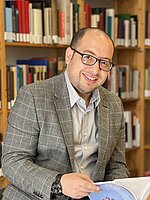
Roxanne Bélanger Sarrazin
Roxanne Bélanger Sarrazin received her doctorate in religious studies (University of Ottawa) and in linguistics, literature, and translation studies (Université Libre de Bruxelles) in 2020. Her revised dissertation, Les divinités gréco-égyptiennes dans les textes magiques coptes, which deals with the appropriation of ancient magical practices by Christians and the processes of religious transformation in late antique Egypt, will soon be published by Peeters in the Orientalia Lovaniensia Analecta series. From 2021 to 2024, she was a postdoctoral researcher in the ERC project APOCRYPHA (University of Oslo), followed by a junior fellowship at the DFG Center Beyond Canon (University of Regensburg). Her research on Coptic apocrypha, magic, and liturgy is culminating in the monograph Apocrypha, Magic, Liturgy. She is also a member of the Philae Temple Graffiti Project. During her stay at MagEIA, she is researching Coptic medical-magical texts and investigating their “vocabulary of healing” in the context of cultural and linguistic exchange processes. CV and Publications |
|

Neda Darabian
Neda Darabian recently defended her doctoral dissertation at the Center for Religious Studies, Ruhr-Universität Bochum, where she explored Jewish-Christian-Zoroastrian encounters in West Asia during Late Antiquity. Her research focuses on discourses surrounding magic in both literary and material sources written in Aramaic, Armenian, Syriac, and Middle Persian. She is particularly interested in the social function of magical accusations and the ways in which magic operated as a discursive category in late antique societies. As part of the MagEIA project, she is working on the identification and classification of distinct types of magic specialists that emerged within the Sasanian world. Her research also aims to develop a more nuanced understanding of how magic, magical practices, and demonic entities were conceptualized by Jewish and Christian practitioners of magic. |
|

Jan Dietrich
Jan Dietrich is Professor of Old Testament at the University of Bonn with a special interest in ancient thinking modes and ancient cultural approaches to crises. As part of his MagEIA fellowship, Jan Dietrich will delve into the quest for ancient magical modes of thought and magical crisis rituals. Are ancient magical modes of thought structured differently from other ancient ways of thinking? Do magical modes of thought in the ancient Near East differ from those in ancient Egypt, ancient Israel, or ancient Greece? In addition to these questions of intellectual history, Jan Dietrich will focus in particular on the phenomenon of magical crisis rituals and examine the specific ways in which magical rituals are used in times of social crisis. What particular constellations arise in the square of magic, religion, law, and knowledge under crisis conditions, and how is (magical) knowledge generated and used to overcome crises? Jan Dietrich will focus primarily on the complex magical crisis rituals which are manifested in different ways in the plague ritual in 1 Samuel 6 and in the famine ritual in 2 Samuel 21. |
|
Reuven Kiperwasser
Reuven Kiperwasser specializes in rabbinic literature. He is a research associate Ben Gurion University in Negev and teaching in Polis, Institute for Humanites, Jerusalem. His research interests include the interactions between Iranian mythology, Syriac-Christian storytelling, rabbinic narrative, and trans-cultural relationships between textual communities of Late Antiquity. Schechter publishing house published his critical edition of Kohelet Rabbah (7-12) with an introduction and commentary in 2021. Braun Judaic Studies published his book Going West: Migrating Personae and Construction of the Self in Rabbinic Culture in 2021. A collection of papers he edited with Geoffrey Herman Expressions of Skeptical Topoi in (Late) Ancient Judaism was published by De Gruyter in 2021. A new book written together with S. Ruzer and A. Kofsky, titled: Late Antique Jewish and Christian Travelogues was published in 2025 by De Gruyter. In the framework of MagEIA Reuven Kiperwasser intends to explore the fragile relationships between Rabbinic literature and the roughly contemporary magic texts on incantation bowls. Rabbinic literature includes numerous references to magical practices, expressions and customs, sometimes disdainfully, sometimes with approval. The Rabbis, as others who lived in a world inhabited by evil forces, tried to cope with its demons, as the authors of incantation texts do. Kipperwasser dealt with this topic in “Solomon and Ashmedai Redux”, JQR 111.1(2021), 21-54 and in “The King of Demons in the Universe of the Rabbis”, Demons in Judaism and Christianity: Characters, Characteristics, and Demonic Exegesis. Edited by Hector M. Patmore and Josef Lössl, 274-293. Recently he has dealt with the shared literary world of Babylonian rabbis and the authors of the incantation texts in “The Rabbinic Body in Magical Texts of the Incantation Bowls” in Aramaic Incantation Bowls in Their Late Antique Jewish Contexts. Alexander W. Marcus, Jason S. Mokhtarian, editors, Brown Judaic Studies, 165-184 |
|
Sofie Schiødt
Sofie Schiødt obtained her doctorate in Egyptology at the University of Copenhagen in 2021, and has since held postdoctoral positions at the University of Copenhagen (2021–2022) and Eberhard Karls Universität Tübingen (2022–2024). Schiødt’s research focuses on social history, medicine and magic, science and technology, and funerary practices. She has produced text editions of three hieratic medical manuscripts in the Papyrus Carlsberg Collection, including the editio princeps of the second-longest medical text surviving from Egypt. Within the MagEIA project, she will investigate how the natural environment was integrated into magical practices, focusing on the role of landscapes and places in the performance of magic in Egypt, informed by comparative perspectives from other historical disciplines and anthropology. |
|
Ulrike Steinert
Ulrike Steinert received her doctorate in Ancient Near Eastern Studies from Georg August University of Göttingen in 2007. Her dissertation, Aspects of Humanity in Ancient Mesopotamia: A Study of Person and Identity in the 2nd and 1st Millennia BC (Leiden: Brill), was published in 2012. Since then, she has worked as a postdoctoral researcher on interdisciplinary research projects, including the ERC project BabMed – Babylonian Medicine (2013–2018, FU Berlin) and the Research Training Group 1876 ‘Early Concepts of Man and Nature’ (2018–2022, JGU Mainz). From 2022 to 2026, she was principal investigator in the DFG project ‘Akkadian and Hittite Emotional Concepts in Context (AHEC)’ at JGU Mainz, where she investigated the linguistic domain of emotions in Akkadian texts from Mesopotamia. In her research, Ulrike Steinert focuses in particular on the interrelated fields of ancient Mesopotamian anthropology, ancient Mesopotamian history of knowledge and medicine, and historical emotion research. Her recently published habilitation thesis Women's Healthcare in Ancient Mesopotamia in the First Millennium BCE (Berlin: de Gruyter, 2026) contains a comprehensive analysis and examination of gynaecological cuneiform texts from the 1st millennium BCE, their concepts of the body and illness, and their therapeutic practices in the field of tension between medicine, magic and religion. As part of the MagEIA project, Ulrike Steinert is investigating emotional metaphors in Akkadian incantations and the rituals associated with them in sources from the 2nd and 1st millennia BC. The focus is on incantations and rituals that explicitly served to control or influence emotional phenomena, such as love spells, incantations to appease anger and ward off hostility, evil demons and harmful spells. The project addresses the question of the extent to which metaphors contribute to cultural models of emotions (or emotion scripts), how linguistic metaphors materialise in magical objects and ritual actions, and how the imagery of magical texts was used as a performative instrument to enable transformations in the psychological states of ritual actors and promote changes in their relationships with their social environment. |
|