500 Years of Writing and Literacy in the Fayum
(2nd Century BCE to 3rd Century CE)
The Package Project PAK 1098
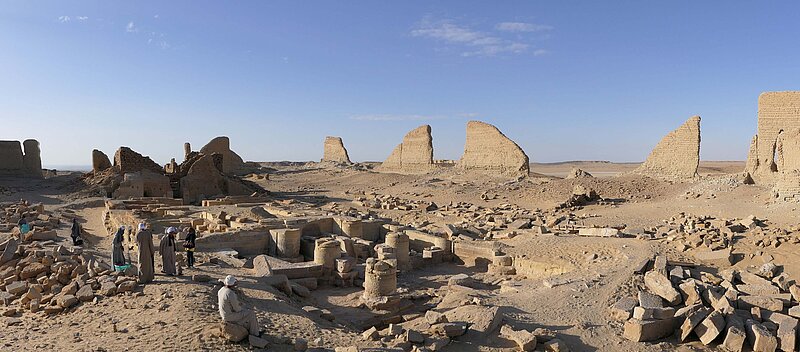
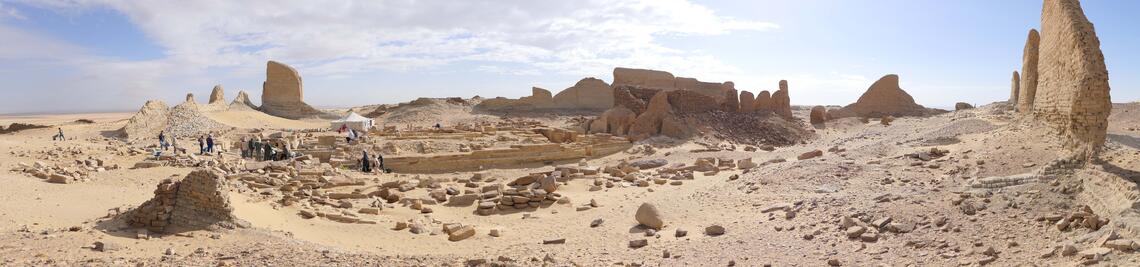
In July 2024, the German Research Foundation (DFG) awarded approximately 1 million Euros to an interdisciplinary research group in Würzburg to investigate the scribal culture of ancient Fayum through a comprehensive analysis of Soknopaiou Nesos. The sources date from the period between the 2nd century BCE and the early 3rd century CE. Almost all of the Demotic documentation and some of the Greek documentation was produced at the town’s cultural and economic centre, the temple of Soknopaios, whilst the grapheion was the most important institution for Greek. There is evidence of collaboration between Egyptians and Greeks, and even of Egyptian priests who simultaneously held notarial offices. Despite the wealth of evidence (or perhaps precisely because of it), this corpus has so far scarcely been systematically studied.
The project team members can build upon a large corpus of relevant sources that have already been identified. However, they must edit further texts in order to obtain a more comprehensive picture. Text types relevant to the topic include Demotic religious sources, Demotic receipts and accounts issued by or for temple staff, Greek documents attesting to communication between temple staff or the temple priest and the Roman authorities, or those relevant to the operation of the grapheion, as well as texts belonging to family or professional archives. The work programme is divided into four research areas. These are addressed in three sub-projects covering overlapping historical periods:
1. A Ptolemaic temple archive (P. Oxf. Griffith) from Soknopaiu Nesos
This sub-project examines the relationship between the Demotic and Greek documentary texts from the temple archive, which is now held in the Griffith and Amherst collections, in order to obtain a more comprehensive picture of the archive as a whole. Of the approximately 300 Demotic papyri, more than half have yet to be published. The key question is the coherence of the Demotic and Greek material as a single ‘archive’ belonging to a single scribe. The aim is to ascertain who wrote the texts, for whom, in which language and for what purpose, and what common features they share. In this way, one can begin to understand the temple as an autonomous organisation within the broader context of Egyptian religion and Ptolemaic state administration. Most of the texts were written by the same scribe, a certain Tesenuphis, son of Marres, ‘scribe of the priests’ in the 2nd century BC. The wealth of texts produced by this scribe will enable us to examine this important scribal office, to investigate what duties he performed, what kinds of texts he wrote, and in what other ways he was involved in the affairs of the temple.
2. Greek Writing Practices in Soknopaiu Nesos
The notary’s office (grapheion) and the local archives are the focus of the second sub-project. The Grapheion can be regarded as the institution that helped to create a ‘middle ground’ between Greek and Egyptian cultural traditions. The aim of the project is to shed light on the relationship between the Grapheion and the temple, as well as its role within the wider legal and administrative institutions of the Ptolemaic and Roman states. 180 notarial deeds form the core corpus of this study, alongside internal Grapheion documents, notarial deeds from related Grapheia and other documents known or presumed to have been drawn up by notaries. Case studies will be carried out on known and newly discovered archives belonging to priests and priestly families. A combined examination of such archives and the institution of the Grapheion will facilitate a better understanding of the social status of the Greeks in Soknopaiu Nesos from the Ptolemaic to the Roman period.
3. Economy and Cultic Practice at the Temple of Soknopaios in Roman Times
The natural next step in the analysis of the accounting scrolls—which was initiated with significant involvement from Würzburg as part of the DimeData project—will also be undertaken by the group: the development of a comprehensive typology for Demotic and Greek accounting scrolls from Soknopaiou Nesos. The aim is to include as many examples of different types of accounting as possible in order to gain a better understanding of the internal temple administration. A particular focus will be on the transition between Demotic and Greek bookkeeping, in order to determine whether there are significant indications of internal Greek bookkeeping at the temple of Soknopaios, and when and how this possible transition took place. In addition, a series of Demotic religious texts will be edited. These works demonstrate how Soknopaiou Nesos extends far beyond the narrow confines of demotic studies and is of interest from a general Egyptological perspective, as it contains the last extant manuscript sources for certain rites. The aim is to lay the foundations for understanding these texts in relation to the practical aspects of temple worship, as revealed by the accounts.