Workshop: Diachrony of linguistic features in South Asian Languages (27.11.2025)
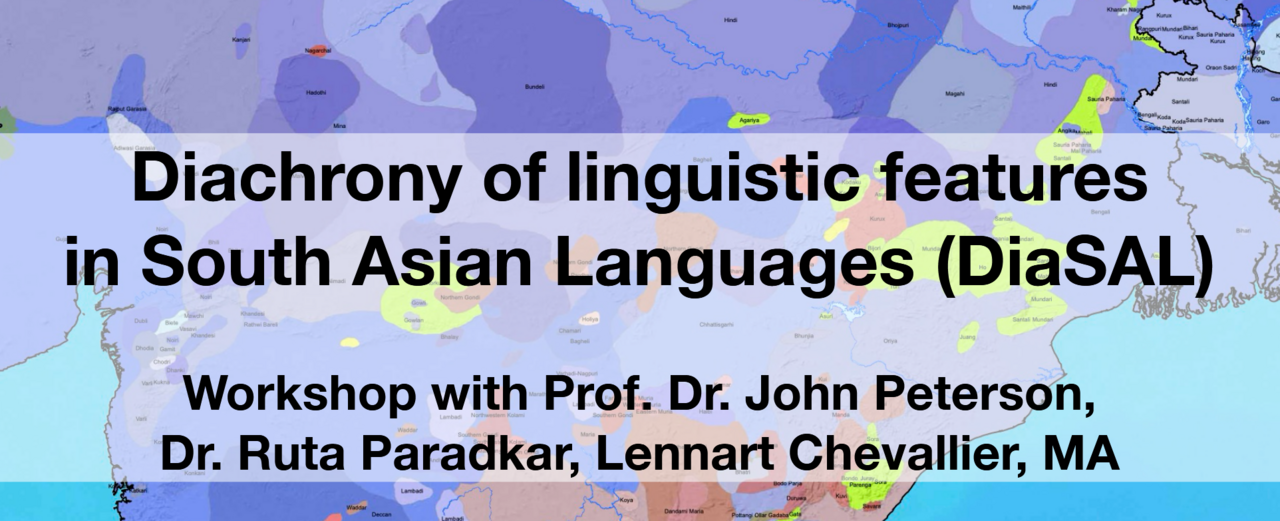
Diachrony of linguistic features in South Asian Languages (DiaSAL)
| Datum: | 27.11.2025, 14:00 - 18:00 Uhr |
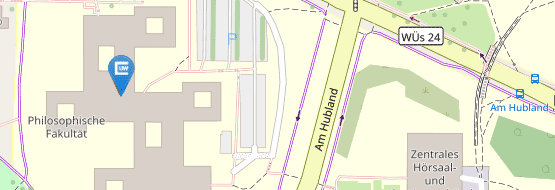
| Ort: | Hubland Süd, Geb. PH1 (Philosophiegebäude), Ü14 |
| Vortragende: | Prof. Dr. John Peterson, Dr. Ruta Paradkar, Lennart Chevallier, MA |
Der Lehrstuhl für Indologie lädt ein zu einem Workshop mit Prof. Dr. John Peterson, Dr. Ruta Paradkar, Lennart Chevallier, MA 27.11.2025, 14:00-18:00 (c.t.) Philosophiegebäude, Raum Ü14, Am Hubland, Universität Würzburg
Diachrony of linguistic features in South Asian Languages (DiaSAL)
Cooperative project by
Prof. Dr. John Peterson (Kiel) and Prof. Dr. Krzysztof Stroński (Poznań)
Funded by the
German Research Council (DFG)
under the cross-border cooperation in a WEAVE lead-agency process with the
Polish National Science Centre (NCN)
In this project we are developing a historical account of areal trends with respect to some 230 typological features in 18 modern and pre-modern varieties of New Indo-Aryan (NIA) and New South Dravidian (NSD) languages. The project will make use of and expand the Kiel South Asian Typological Database that includes data from 42 modern languages. The combination of historical and modern data for individual languages from two different families from throughout the subcontinent will contribute to a better understanding of structural changes in these languages, in particular with respect to language contact, and will go beyond simply identifying features pertaining to a linguistic area. In doing so, it will also serve as a basis for developing a typology of contact situations of general interest beyond just South Asian linguistics.
The team in Poznań is focusing on the Indo-Aryan languages Kashmiri, Chambiyali, Garhwali, Kumaoni, Punjabi, Rajasthani, Braj, Awadhi, Nepali, Maithili, Assamese, Bengali of northern and eastern India as well as the Dravidian language Tamil in southeast India, while the team in Kiel is concentrating on the west coast of India, focusing on the Indo-Aryan languages Marathi, Konkani and Gujarati and the Dravidian languages Kannada, Tulu and Malayalam. Above all, our work is in the states of Karnataka and Goa, both of which lie on the west coast of India.
By comparing pre-modern stages of these languages with their corresponding modern structures and interpreting this data in light of the known history of these regions the teams hope to be able to determine which changes are due to purely language-internal developments and which are most likely attributed to language contact—one such example of contact-induced change between Kannada and Goan Konkani is negation (Peterson & Chevallier 2022).
We will provide an overview of the Kiel South Asian Typological Database which was developed in the earlier Kiel DFG-funded project (“Towards a linguistic prehistory of eastern-central South Asia (and beyond)”), and discuss our work in the current project “Diachrony of linguistic features in South Asian Languages” (DiaSAL), especially with focus on the Goa-Karnataka border region.
The Kiel Team: Prof. Dr. John Peterson, Dr. Ruta Paradkar, Lennart Chevallier, MA, Shane Arzbach, Shristi Panna, and Bo Muhlack.
References:
Peterson, John & Lennart Chevallier. 2022. Towards a Typology of Negation in South Asian Languages. Bhāṣā, Journal of South Asian Linguistics, Philology and Grammatical Traditions. 1(1), 17–62. DOI: 10.30687/bhasha/8409-3769/2022/01/005.