


Planting Future: Multispecies Gardening in the Anthropocene
VW-Research Group:
Planting Future: Multispecies Gardening in the Anthropocene
(2025-2030)
Funded by Volkswagen Foundation
Practice partner: Bayerische Gartenakademie, Head: Claudia Schönmüller
Principal Investigator:
- Prof. Dr. Michaela Fenske
Team:
Bayerische Gartenakademie
- Claudia Schönmüller, Graduate Engineer
- Benjamin Roos, Graduate Engineer
- Hubert Siegler, Graduate Engineer(until August 2025)
- Silke Knopp, Master Gardener
- Isolde Keil-Vierheilig, Horticultural Technician
- Kristin Mahler, Horticultural Technician
- Gottfried Röll, Horticultural Technician
- Doris Winkler, Administration Secretary
European Ethnology
- Researcher: Dr. des. Julia Gilfert
- Researcher: Sherin-Michelle Grabenstein, M.A.
- Student assistants: Eric Fleming + Judith Ocker
- Graduate assistants: Anna Lena Seitz B.A.+ NN
- Intern: Markus Lüske
Contact: multispeciesgardening@uni-wuerzburg.de

NEW: NACHGEHA(R)KT! The MultiSpecies Gardening Research Group’s Expert Talk
In our new audio format, we talk to scientific researchers and gardening experts about selected topics from our field.



People are increasingly becoming aware of the need for transformation within their everyday world. In this respect, private gardens constitute arenas of learning transformation within the polycrisis by small scale activities that add up to produce major effects. The transformation asks for new practices, plants, and fruits, as well as for new attitudes, ethics, and aesthetics.
The Chair of European Ethnology/Cultural Analysis at the University of Würzburg and its partner, the Bavarian Academy for Private Horticulture in Veitshöchheim, combine their theoretical and practical expertise to understand transformation within the context of private gardens.
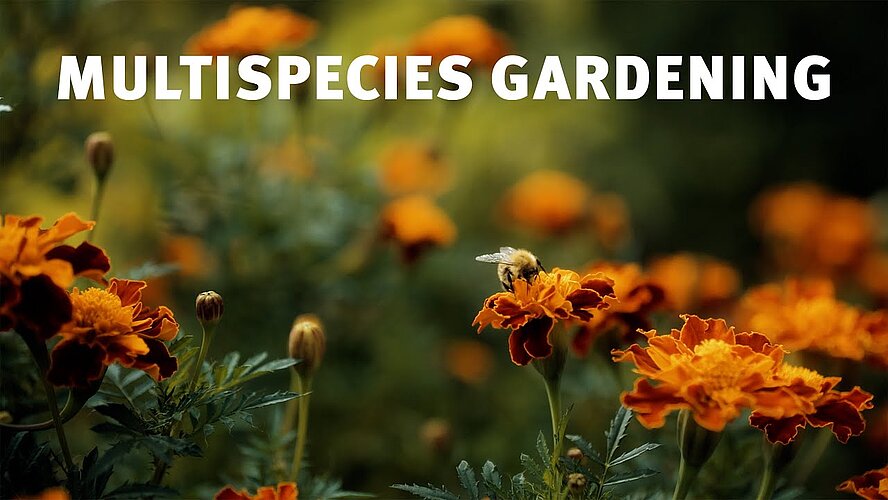
Aims of the project
The project will
- explore and communicate the experience people make concerning the socio-ecological crisis in their gardens
- train the awareness for gardening as a multispecies practice, a practice that combines the efforts of plants, animals, and humans.
- demonstrate the tremendous potentials of gardens as places that enable societies to experience resilience.
This subproject deals with experiences in the everyday space of the garden in the polycrises of the early 21st century. In their gardens, people experience other living beings every day, because gardens are increasingly important living spaces and shelters for many animals and plants in the 21st century. The subproject deals with the perception of changes, suggestions for dealing with them, and their practical implementation. In this context, the challenges and obstacles of gardening in our time are also addressed. The subproject aims to explore the potentials of the garden space and the practices of gardening for learning about and shaping change. In doing so, the subproject focuses on gardens as spaces for strengthening resilience and sustainability.
Gardens are constantly changing. Environmental influences, switching actors and socio-cultural imaginations have an impact on them. As a result, the understanding of (sustainable) gardening and the respective practices are continuously reshaped: Gardeners question and evaluate their own knowledge as well as it is questioned and evaluated by others. On the one hand, sub project 2 examines the gardeners‘ corpus of knowledge and the ideas of ethics and aesthetics behind it. On the other hand it focuses on how this knowledge is generated and set into practice in times of transformation. Against the background of changing needs and potential effects on cross-species knowledge transfer, the emerging tensions between various ‚multispecies garden actors‘ will also be addressed.
Being inhabited, treated and shaped by many different species, gardens are dynamic living spaces. While some of these species are heavily threatened by the current global polycrisis, others, in turn, are enabled to occupy new areas due to climate change. This subproject focusses on non-native/alien invasive species (neobiota) – meaning animals, plants or fungi as well as microorganisms. Considering ethical, political, aesthetic and emotional aspects, the subproject will discuss how gardeners face different neobiota, what practices they develop in dealing with them, and how these non-native species are constructed within societal discourses and in the media.
Tagung 2026: Zukunft pflanzen? Neue Früchte und alte Sorten in ländlichen Ökonomien
September 10–12, 2026
A conference organized by the Chair of European Ethnology at the University of Würzburg and the Bavarian Academy for Private Horticulture in Veitshöchheim (funded by the VW Research Group Multispecies Gardening) as well as the Commission for Cultural Analysis of the Rural of the DGEKW.
Motivated gardeners wanted!
The research group “Planting Future: Multispecies Gardening in the Anthropocene” is looking for committed gardeners to exchange ideas in the form of conversations, garden tours, photos, or stories for their research on gardening under today's conditions. The project, funded by the Volkswagen Foundation, focuses on private gardens as places of central importance for many people. We see gardens as both the scene of current changes (transformation) and as special places of social adaptability (resilience). One focus is on how people interact with other garden inhabitants such as plants, birds, or insects.
Curious? Please get in touch with us! multispeciesgardening@uni-wuerzburg.de

Storytelling is a force for shaping the world! Through storytelling, hopes are realized, fears are addressed, and community is strengthened.
We invite you to tell us your garden stories!
- Gräber und Grünflächen naturnah gestalten (sobla.de, 24.06.2025)
- Uni Würzburg: Gärtnern gegen die Polykrise (gabot.de, 20.02.2025)
- Pressemitteilung: Gärtnern gegen die Polykrise (JMU, 13.02.2025)