

Planting Future: Multispecies Gardening in the Anthropocene
VW-Research Group (2025–2030), funded by the Volkswagen Foundation
In light of ecological crises, more and more people are recognizing the need for transformation in their daily lives. Gardens are central to this process, for it is here that we learn, on a small scale, what has an impact on a larger scale: The polycrisis calls for new practices, ethics, and aesthetics, as well as new ways for convivality with different species.
The Project is meant to
- understand and communicate people’s experiences related to the socio-ecological crisis in their gardens
- raise awareness of gardening as a multispecies practice—that is, a practice in which the efforts of plants, animals, and humans work together
- highlight the considerable potential of gardens as places that enable society to build resilience.
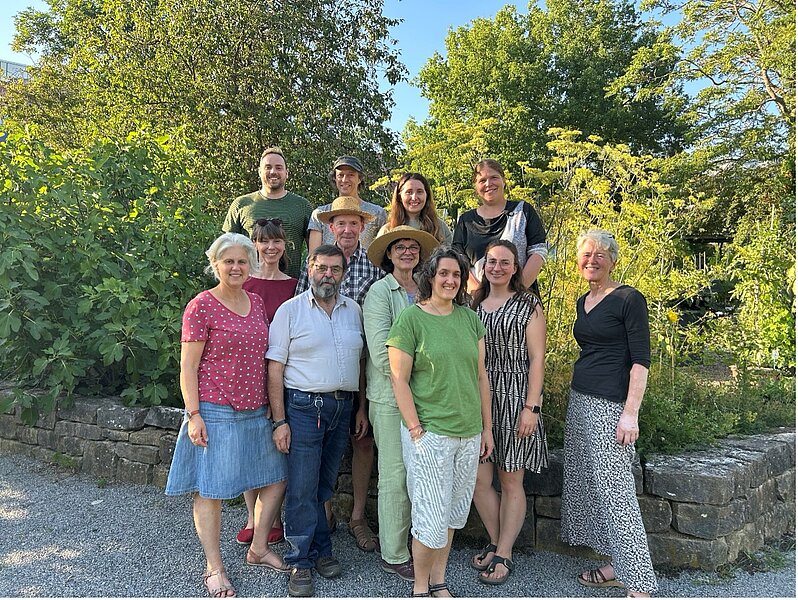
The Chair of European Ethnology/Empirical Cultural Studies at the University of Würzburg and the Bavarian Garden Academy combine theoretical and practical expertise in understanding socio-ecological transformation in the context of private gardens.
Prinicipal Investigator: Prof. Dr. Michalea Fenske
Practice Partner Bayerische Gartenakademie, Head: Dipl. Ing. Claudia Schönmüller



European EthnologyPrincipal InvestigatorResearcherGraduate Assistants
Student Assistants
Interns
| Bavarian Garden Academy
|
Latest News
Looking for Gardeners!
The research group is looking for dedicated gardeners to share ideas through conversations, garden tours, photos, or stories (meetings are also online possible). Interested? For further information, please get in touch with us!
Conctact: multispeciesgardening@uni-wuerzburg.de
Out Now: First Episode of our Podcast Series „Nachgeha(r)kt“ is out now
Researcher: Prof. Dr. Michaela Fenske
(knowledge formats: monograph, multispecies storytelling, film, exhibition)
This subproject deals with experiences in the everyday space of the garden in the polycrises of the early 21st century. In their gardens, people experience other living beings every day, because gardens are increasingly important living spaces and shelters for many animals and plants in the 21st century. The subproject deals with the perception of changes, suggestions for dealing with them, and their practical implementation. In this context, the challenges and obstacles of gardening in our time are also addressed. The subproject aims to explore the potentials of the garden space and the practices of gardening for learning about and shaping change. In doing so, the subproject focuses on gardens as spaces for strengthening resilience and sustainability.
Researcher: Sherin-Michelle Grabenstein
(knowledge formats: monograph, multispecies storytelling, film, exhibition)
Gardens are constantly changing. Environmental influences, switching actors and socio-cultural imaginations have an impact on them. As a result, the understanding of (sustainable) gardening and the respective practices are continuously reshaped: Gardeners question and evaluate their own knowledge as well as it is questioned and evaluated by others. On the one hand, sub project 2 examines the gardeners‘ corpus of knowledge and the ideas of ethics and aesthetics behind it. On the other hand it focuses on how this knowledge is generated and set into practice in times of transformation. Against the background of changing needs and potential effects on cross-species knowledge transfer, the emerging tensions between various ‚multispecies garden actors‘ will also be addressed.
Reseacher: : Dr. Arnika Peselmann
Gardens have a long tradition as places of healing: whether through the cultivation of medicinal and therapeutic plants, through their special design intended to promote physical and, above all, mental regeneration, or through gardening practices that are increasingly becoming part of therapeutic approaches. In light of massive socio-ecological crises, however, the process of healing is no longer limited to human health but has been expanded to include the health of plants, animals, the soil and others. From a multispecies perspective, this subproject examines how private and community gardens are perceived, used, and designed as places of healing, and what conceptions of “more-than-human” health emerge
Podcast „Nachgeha(r)kt“
In our podcast series „Nachgeha(r)kt“, we talk with experts from different fields about one particular topic in horticulture and gardening. (in German only, please find a short summary of every episode in English)
Episode One: The Hedgehog: I will stay if you let me.
For the first episode, research associate Julia Gilfert talked to Volker Zahner, professor of zoology and wildlife ecology at Weihenstephan-Triesdorf University of Applied Sciences, about the brown-breasted hedgehog.
Storytelling is a force that shapes the world! Through storytelling, hopes are realized, fears are addressed, and a sense of community is strengthened. Here you find already some garden stories (in German, and a few in English)
We invite you to also share your garden stories with us!
Here, we share some of our experiences from our visits to gardens all over Germany. Thereby we would like to express our appreciation for the dedication and expertise of our research partners by sharing their insights as well as their findings and gardening tips in the Anthropocene. (in German only)
- Ab ins Grüne – für die Forschung (HERZOG. Kultur- und Stadtmagazin 16.08.2026)
- Lebendige Erde (4 - 2026)
- Gartenratgeber 4 (2026)
- Mit Gärtnern durch die Polykrise (Kraut&Rüben 2/2026)
- Gräber und Grünflächen naturnah gestalten (sobla.de, 24.06.2025)
- Uni Würzburg: Gärtnern gegen die Polykrise (gabot.de, 20.02.2025)
- Pressemitteilung: Gärtnern gegen die Polykrise (JMU, 13.02.2025)